The sea was glass.
Dead calm. Not a wave, not a whisper. Only the low groan of the ship’s hull and the distant, creak of ropes.
Then we saw her—a pale silhouette on the horizon, rising from the fog like a lie made flesh.
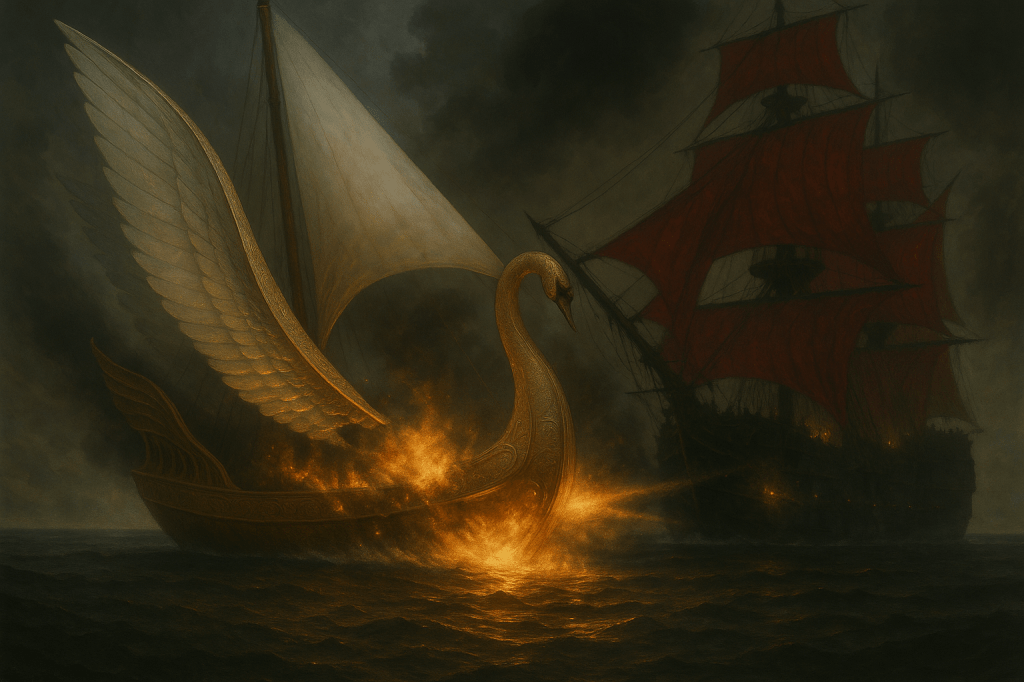
The Innarlithian War-Swan.
Gold-gilded hull. High wings carved from silver-laced cedar. Sails white as purity and just as false. At her prow, the crowned sunburst of the Dragon Queen glared like judgment—imperious, radiant, and utterly unearned.
A hush fell across The Hag’s deck. The wind died, as if the world itself held its breath.
Captain Grebdin stood at the prow, a coal-black titan of a minotaur, still as carved obsidian. He raised his massive spyglass, took one long look, then spoke with the voice of a mountain cracking:
“Master Sarr. Send our word.”
The elven magister moved quickly, robes billowing in sudden arcane wind. A raven of midnight ink and green flame took shape on his outstretched palm. Into its mind he whispered Grebdin’s message:
“Venture no closer.
The Hag is sovereign. Your Dragon Queen holds no dominion here.
Test us, and suffer the full extent of our wrath.
Turn now. Or be unmade.”
The raven launched, slicing across the sky like a dark blade.
It did not make it far.
A streak of gold light—swift, cruel, precise—pierced the sky and struck the raven mid-flight. The bird exploded in a shriek of embers and feathers.
A shot. A warning. A challenge.
“Raise the warning flags,” Grebdin growled, turning slow and terrible toward the quarterdeck.
“Sound three bells.”
“Ready all.”
“And await my word.”
A flurry followed. Boots on planks. Steel on steel. Sails creaking into position. The hum of sigils being carved anew along the gun rails. Fear, yes—but purpose too. For we knew who stirred in the belly of the ship.
From below—the underhold—he came.
Kraglann.
Siege Master. Warlock. Bringer of Ruin.
He strode forth like a spirit of vengeance given flesh—short, broad, his umber skin smudged with soot, eyes bright with unshed madness. His beard was ragged, singed, and wild. His coat scorched, charred at the hems. Burnt leather hung from his shoulders like old battle flags.
And as he passed each cannon along the gun deck, he spoke to them.
Whispers in a tongue none of us knew. Not elven, not dwarven, not any human dialect. It was older. Hungrier.
The cannons hummed in reply.
He touched each one as if it were a priest touching holy stone. Each barrel responded with a low, eager groan. The runes etched into their sides—runes only Kraglann understood—flared with dull, red heat.
His battlelust was a force. A gravity that bent the air around him.
And this wasn’t just battle.
This was vengeance.
Through his spyglass, the Captain watched the War-Swan close in. No hesitation. No shift in course.
A wind-mage stood at her foredeck now, arms raised. The air around him shimmered and swirled with unstable power.
Their answer was clear. They would not turn.
So Grebdin lowered the glass.
And he gave the words that cracked the world open.
“Burn her to the waterline.”
“No quarter.”
“The cannons are yours, Kraglann.”
And then—gods help us all—the siege master smiled.
From Kraglann’s War-Journal
Scrawled with black soot, stained with salt, seared along the margins by smoke.
The Captain said the words.
He never says the words. Not like that.
“Burn her to the waterline.”
“No quarter.”
“The cannons are yours, Kraglann.”
And I—
—I felt it.
Like a thousand iron chains snapping in my chest.
Like the first scream of a god in the deep.
It was an Innarlithian war-swan. Gold-plated, elegant, sails like temple spires, every inch of her a monument to their queen’s obscene pride. Painted with fire she does not understand. Banner stretched wide in arrogant silk.
She glided across the sea like she owned it.
Not anymore.
The first volley was mine before the last syllable left Grebdin’s mouth.
“Range,” I barked. “Wind.”
“Elevation—no. Higher. Let her feel it.”
The crew jumped to my voice like it was the crack of lightning. They always do, when the leash is off. They fear me. I let them.
The first broadside screamed.
The thunder of the blast rolled across the waves like a stormcloud shattering. Her starboard wing erupted—splinters and fire pouring down her hull like molten grief. Screams echoed. I heard them. I laughed.
The second volley was overkill.
I walked the line between the long guns and whispered to each one. The old tongue. The god-tongue. My tongue. The runes on my leathers flared. My hands shook with power not entirely mine.
“Feed,” I whispered to the cannons.
“Take what you will. Burn her. Burn her down to the bones.”
The Hag became a living altar. Fire and steel the blood offering.
Volley after volley. The war-swan turned from beauty to ruin in a matter of seconds. No quarter. No warning shots. No survivors.
Her sails caught fire before the second volley. Sails made not to burn, magiced not to burn, yet burn they did. Like kindling. The main mast cracked like a dry bone. Figures leapt to the sea—too slow, too late. We had already killed the soul of her.
I raised my arms and shouted words that burned the ears of those who heard. And the sea around the Swan became flame, hungry endless flame, devouring all it could reach as the ruined ship drifted into the inferno of my making.
And through it all, I stood at the gun deck, boots nearly alight from heat, coat scorched by blasts, teeth bared in something too wild to be called a smile.
And behind me, Grebdin stood silent. Watching. His eyes full of grim satisfaction. Of purpose fulfilled.
He did not need to speak again.
Because I knew.
This is what I was made for.
Not peace. Not politics.
But war—pure, unchained, and fed with fire.
And when the last of the swan’s gilded hull slipped beneath the waves, the smoke curling like incense into the dark sky—I turned to him.
“The beast is fed,” I said.
He nodded. No pride. No fear. Just understanding.
Then he raised a hand—slow, deliberate.
And the leash went taut once more.
Bosun Sedrik Macill, Diary notes
I should have jumped. I should’ve jumped. The sea would’ve been kinder.
I thought I’d seen horror. I’ve held the line at Port Wroth. Survived the Night Siege at Frostharbor. I watched red sky rain men from a skyship ablaze. But none of it—none—comes close to what I saw when the Captain gave Kraglann the guns.
I was belowdecks, powder line. Just another hand on the rope, hauling, loading, resetting. You don’t think down there—you just obey. You move or you burn. But then I heard it—his voice. Kraglann. Loud. Clear. Like molten rock tearing through your ribs.
“Feed the beast.”
He said it out loud.
Then the first blast hit. I thought we’d run aground. The walls screamed. My ears bled. I looked up the ladderwell and saw light where there should’ve been shadow—light and smoke and fire and that sound again, the one that lives in your bones.
The Innarlithian ship a War-Swan, it was a damn cathedral on water. Beautiful. Unbreakable.
Kraglann broke it.
He broke it with fire.
He walked along the gun deck like he was anointed, speaking to the cannons like they were saints. He glowed—I swear on my mother’s grave, he glowed. Not with light. With power. Wrong, old, deep power. You could feel it in your teeth. In your marrow. The way prey must feel a lion’s breath before the pounce.
And all the while, the Captain just stood behind him. Watching. Letting it happen. No orders. No corrections. Like he’d finally opened a cage and didn’t care what came out—as long as it went forward.
When the war-swan sank, it didn’t just burn. It screamed.
And Kraglann stood there, arms out, black coat tattered and flickering at the edges, laughing into the smoke.
I won’t sleep again.
Not with that sound in my ears.
Not with that look in his eye.
Not with the smell of charred gold and boiled silk hanging in my clothes.
Gods forgive us.
I think we liked it.
 Shermans fantasy world