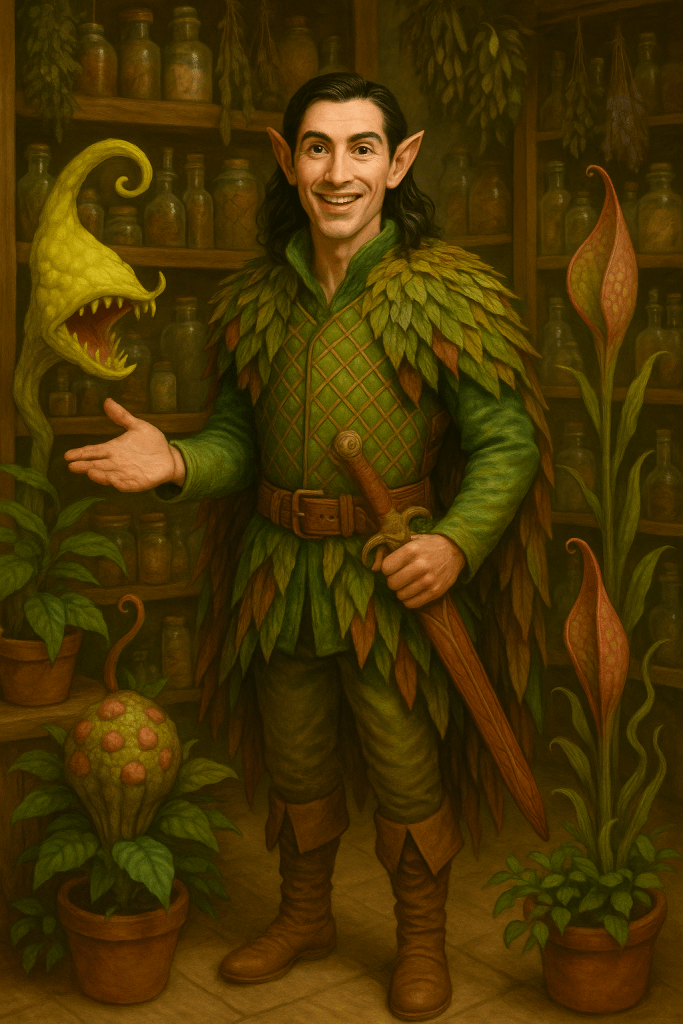
“Ah, welcome once again, dear traveler. I see the curiosity in your eyes, and I can almost taste the excitement in the air. You’ve come seeking the rare and the exotic — the plants that live, grow, and act. You may not find your typical potted petunia here. No, no, I specialize in the dangerous, the strange, and the potentially fatal. But don’t worry—only if you misstep! I do not deal with fungus nor the vile spore-spreading monstrosities. I remain true to my botanical studies. Now, allow me to present to you a few of the wonders that populate my collection. But be warned: they are not for the faint of heart, and I highly recommend keeping a safe distance when observing them in their natural state.”
Medicinal Plants
1. Silverglass Reed
Appearance: Tall, translucent stalks that shimmer like polished glass under sunlight. Tiny silvery barbs along the stems.
Unique Trait: The sap, when distilled, is a miracle antiseptic capable of healing grievous wounds quickly.
Elith’s Comment:
“You must cut it at moonrise, lest the reed weep itself dry and useless! Marvelous against sepsis — saved my leg once, after a tragic misunderstanding with a Root Strider!”
2. Sunshroud Moss
Appearance: Golden-yellow moss that glows faintly, especially around wounds.
Unique Trait: Placed on the skin, it accelerates natural healing, closing minor wounds overnight.
Elith’s Comment:
“A patch of Sunshroud, and you’ll be singing sooner than you should. Careful, though — the moss hates being too dry, the little darlings die of heartbreak!”
Poisonous Plants
1. Venomwood Vine
Appearance: Black, wiry vine covered in sickly green leaves. Tiny crimson thorns pulse visibly with toxic sap.
Unique Trait: Thorns inject a paralytic venom when they pierce flesh; extremely fast-acting.
Elith’s Comment:
“Charming conversation piece! But mind your sleeves, or you’ll find yourself part of the decor, stiff as a dead rat on Midsummer’s Day!”
2. Widow’s Bloom
Appearance: A beautiful black rose with deep violet veins and a silver stem.
Unique Trait: Emits a pollen cloud at maturity that causes hallucinations, seizures, and death if inhaled in large doses.
Elith’s Comment:
“Ah, the Widow’s Bloom! Just one sniff and you’ll see the Seven Hells… and perhaps shake hands with a few of its residents!”
Crafting Plants
1. Heartwood Tree
Appearance: A gnarled, ancient tree with bark the color of dried blood and wood that glows faintly from within.
Unique Trait: Heartwood is impossibly durable — often used for magical staves, spear shafts, and shields.
Elith’s Comment:
“You can split stone with a Heartwood spear and barely dent the tip! The trees, however, do bite back if you anger them during the harvest.”
2. Venomwood (Processed)
Appearance: When dried and treated, Venomwood vines can be twisted into poison-infused arrow shafts that deliver toxin on impact.
Unique Trait: Inflicts natural poisoning without needing an extra poison coating.
Elith’s Comment:
“Economical and deadly — two virtues that any discerning adventurer appreciates! Just don’t put them in your mouth. Foolish apprentice learned that the tragic way.”
Exotic / Unique Plants
1. Whisperfern
Appearance: Ferns with shimmering silver fronds that seem to rustle words into the air.
Unique Trait: When brushed, the leaves ‘whisper’ the last sounds they heard — can be used for spying!
Elith’s Comment:
“Oh, the sweet Whisperfern! Many an unfaithful heart has been undone by their gossipy little sighs. I find it scandalously delightful.”
2. Lantern Lily
Appearance: Bulbous flower that glows a soft blue at night; the petals form natural ‘shades’ like tiny lanterns.
Unique Trait: Can illuminate a small area without flame; incredibly popular among elven caravans.
Elith’s Comment:
“A travelling friend to the wise and the whimsical alike. They follow you about like puppies if you hum to them! Absolutely endearing.”
3. Dreamleech Blossom
Appearance: Pale white flower with long drooping petals and a heavy, sweet scent.
Unique Trait: If inhaled, it induces vivid dreams of possible futures — or nightmares of unavoidable fates.
Elith’s Comment:
“I tried growing a hedge of these once! Terrible idea. Lost three apprentices to existential despair. Marvelous blooms, though!”
Ambulatory Carnivorous Plants
1. Delthiki (Blood Pumpkin, Hack-o’-Lantern)
Appearance:
Large, round gourd-like bodies about the size of a sheepdog, mottled in dark oranges, sickly greens, and blood-black blotches. Sharp, twisted thorny vines (sometimes up to 10 feet long) snake outward from the base. At a distance, a patch can resemble a half-rotted pumpkin field — until it moves.
Unique Traits:
Anticoagulant and Numbing Sap:
Even the lightest scratch from a Delthiki thorn causes blood to flow freely for hours without clotting. Victims often don’t notice until they’re dizzy from blood loss.
Carnivorous Patches:
When injured creatures stumble or collapse nearby, thousands of vines swarm over them, impaling and draining them completely. Bones and hides are left behind tangled in the mats.
Migration Phase:
Late fall, the Delthiki uproot, crawling miles across the countryside to form new patches. A terrifying rustling, dragging sound heralds their coming. Their advance leaves behind trails of stripped, bloodless corpses.
Elith’s Comment:
“Oh, the majestic horror of the Delthiki! Why, my last assistant mistook them for a quaint little pumpkin patch — a mistake he shall never repeat, poor dear. In a mere six minutes he was quite… exsanguinated. (Marvelous specimen we preserved though!) I keep a young sprout chained in the back; splendid conversation starter.”
2. Root Striders
Appearance:
Twisted stumps and gnarled roots that pull themselves along the ground using thick tendrils. Their bark resembles common fallen wood until they lash out.
Unique Traits:
Grab ankles and legs to trip and immobilize prey.
Feed off the life force and blood of anything they drag underground.
Elith’s Comment:
“Charming fellows if you stay atop a large rock. Otherwise, they’ll dance your bones a merry jig underground!”
3. Spine Creepers
Appearance:
Thin, vine-like plants that sprout thorned tendrils shaped like grotesque, spidery hands. Pale, ashen green color.
Unique Traits:
Can cling to ceilings or walls and drop down on passersby.
Inject a paralyzing toxin that leaves victims awake but unable to move.
Elith’s Comment:
“Wonderful for defense — I have three planted above my cash box. Only a few minor lawsuits, but priceless security!”
Rare Plants Only Available Under Strange Conditions
1. Moondrinker Ivy
Appearance:
Silvery-white ivy that only unfurls its petals under full moonlight, glowing like woven frost.
Unique Trait:
Absorbs moonlight to create a powerful restorative potion ingredient — or a potent magical catalyst.
Condition:
Must be harvested by bare hand under direct full moon without casting your own shadow upon it.
Elith’s Comment:
“Delicious little things! The trick is to dance around the vines naked during harvest — not strictly necessary, but highly recommended for effect!”
2. Starrot Bloom
Appearance:
A black, five-petaled flower with glittering motes like distant stars.
Unique Trait:
Emits a scent that kills insects and weakens magical wards nearby.
Condition:
Only blooms during solar eclipses — and only on graves of spellcasters.
Elith’s Comment:
“Grows best on the sorcerously deceased! Bring your own necromancer if necessary; they’re marvelously fertile with the right application of moon-spun fertilizer.”
3. Sighing Hemlock
Appearance:
A tree whose pale blue leaves constantly “sigh” — a low, mournful sound that never stops.
Unique Trait:
Its wood is a potent component in making musical instruments that control emotions (joy, grief, rage) in listeners.
Condition:
Will not grow unless a bard has died within 100 feet of the seed.
Elith’s Comment:
“I planted one in the courtyard. Absolutely ruins romantic picnics — constant weeping, fainting, or fits of raving fury! Delightful party piece.”
Monster Statblock: Delthiki (Blood Pumpkin)
Delthiki (Blood Pumpkin)
Large Plant, Unaligned
Armor Class: 14 (natural armor)
Hit Points: 95 (10d10 + 40)
Speed: 20 ft., burrow 10 ft.
STR: 19 (+4)
DEX: 10 (+0)
CON: 18 (+4)
INT: 1 (-5)
WIS: 10 (+0)
CHA: 3 (-4)
Saving Throws: Con +6
Damage Resistances: Piercing, slashing (non-magical)
Damage Vulnerabilities: Fire
Condition Immunities: Blinded, deafened, frightened, prone
Senses: Tremorsense 60 ft. (blind beyond this radius), passive Perception 10
Languages: —
Challenge: 5 (1,800 XP)
Abilities:
Bloodletting Thorns:
When a creature is hit by a Delthiki thorn attack, it must succeed on a DC 14 Constitution saving throw or bleed uncontrollably. Until the bleeding ends, the creature takes 7 (2d6) necrotic damage at the start of each of its turns. A creature can end this effect with a successful DC 14 Medicine check or magic that restores hit points.
Migratory Swarm:
During the Fall Season, multiple Delthiki can uproot and migrate together. Groups of 3 or more gain advantage on attack rolls and saving throws.
Actions:
Multiattack:
The Delthiki makes two Thorn Lash attacks.
Thorn Lash: Melee Weapon Attack: +6 to hit, reach 10 ft., one target.
Hit: 12 (2d8 + 4) piercing damage plus Bloodletting Thorns effect.
Grasping Vines (Recharge 5–6):
The Delthiki extends a mass of vines in a 15-foot radius. Each creature in that area must succeed on a DC 14 Strength saving throw or be restrained (escape DC 14). Creatures restrained this way take 10 (3d6) piercing damage at the start of each of their turns.
Field Guide Entry: Delthiki
Illustration: a gnarled pumpkin covered in thorned, whip-like vines with blood dripping from the ends; background littered with skeletal remains.
“Observe the haunting migration of the Delthiki! Autumn’s ghastly parade of bloodless bones, the fields red with the lifeblood of the unwary! Truly one of nature’s grandest entertainments.” — Elith Kralnewbar
Expanded Rare/Deadly Plants
Redgullet Tulips
Appearance:
Large tulip-like blossoms with red-veined petals and fang-like internal structures.
Unique Trait:
Hop after prey with jerking, twitchy motions. Open wide to swallow small creatures whole (size Tiny or smaller).
Elith’s Comment:
“They once devoured an entire school of froglets — magnificent massacre. I recommend them to lonely gardeners craving companionship… or something to terrorize their neighbors!”
Harrow Briars
Appearance:
Black, skeletal briar clusters that creep like slow-moving hedgehogs.
Unique Trait:
Strip flesh from bones with their thousands of needle-thorns; when cornered, they “ball up” and launch themselves at attackers.
Elith’s Comment:
“Useful for clearing graveyards of pesky resurrectionists and nosy priests. Rather…final…in their gardening techniques.”
Wanderwort
Appearance:
A thick, fuzzy moss that extrudes spindly “legs” made of tangled roots.
Unique Trait:
Consumes all organic matter it covers — plants, flesh, even wood. Travels slowly but tirelessly, leaving polished stones and barren ground behind.
Elith’s Comment:
“One can watch it work for hours! Like a lazy doom inching across the lawn. Some customers use it for… ‘problematic landscaping’.”
Elith’s Personal Collection (“Absolutely Not for Sale!”)
1. Vel Vein Orchid
Appearance:
Ethereal purple-black orchid with twitching roots.
Unique Trait:
Drinks magic directly from spellcasters within 30 feet. Prolonged exposure leaves wizards gibbering and dry-eyed, unable to even light a cantrip.
Elith’s Comment:
“One touch and you’re a sobbing, empty little husk. I keep her in the parlor for guests I find… tedious.”
2. Gorefruit Bloom
Appearance:
A tree bearing heavy, glistening fruits that pulse faintly, as if they have heartbeats.
Unique Trait:
Fruit explodes violently when ripe, splattering blood-like ichor that induces berserk rage in creatures struck (DC 15 Wisdom save or attack nearest creature).
Elith’s Comment:
“Absolutely exquisite centerpiece for duels! Hosted a wedding once with one as decoration — only three fatalities. Remarkable restraint, really.”
3. Twilight Maw
Appearance:
A low, ground-hugging plant whose massive purple-and-black bloom has rows of hidden teeth inside.
Unique Trait:
Opens suddenly to engulf large prey (size Medium or smaller). Digestive acids harden into highly-prized alchemical crystal after feeding.
Elith’s Comment:
“Oh, if you must sell a relative’s soul, why not let a plant handle the messy bits? Leaves a lovely gem afterward!”
Potions and Alchemical Concoctions
Potion of the Crawling Blood
Ingredients: Delthiki thorn sap, Redgullet nectar
Effect:
When drunk, for 1 minute your blood flows like quicksilver: you automatically succeed on the first death saving throw if reduced to 0 HP during the effect, and bleed only half normal blood loss.
Elith’s Pitch:
“Ever feel like your body’s trying to stay alive without your help? No? Well, you will.”
Elixir of Vengeful Roots
Ingredients: Harrow Briar thorns
Effect:
Drink to grow long, thorned vines from your arms for 1 hour. You can attack with the vines (1d8 slashing, reach 10 ft.) and restrain creatures (Strength contest vs DC 15).
Elith’s Pitch:
“Impress dates, terrify in-laws, embrace strangers without permission!”
Gorefruit Rage Brew
Ingredients: Distilled Gorefruit sap
Effect:
For 1 minute after drinking, you enter a rage (as barbarian Rage, but no damage resistance). +2 melee damage bonus, but must attack something every round.
Elith’s Pitch:
“One bottle. Five minutes. Twelve regrettable decisions. Worth it!”
Magic Seeds & Instant Botanical Summons
1.Briarburst Seed
Description:
A black, pebble-like seed with tiny crimson veins pulsing just under its surface.
Activation:
Throw at a surface. On impact, it explodes into a 10-foot radius patch of razorvine.
Effect:
Creatures moving through the area must succeed a DC 14 Dexterity save or take 2d6 slashing damage and have movement halved.
Elith’s Pitch:
“Don’t like the odds? Grow your own battlefield.”
2.Wanderwort Tanglepod
Description:
A soft, furry seed-pod that twitches slightly if you stare too long.
Activation:
Throw at a point within 30 ft.
Effect:
A living mass of grasping moss erupts. Targets in a 10-foot radius must succeed a DC 15 Strength save or be restrained by grasping tendrils.
Elith’s Pitch:
“Best party trick in the Eastern Realms. Instant crowd control!”
3.Tanglemace Seed
Description:
A gnarled brown nut with small thorny barbs sticking out.
Activation:
Plant in loose soil or slam into the ground.
Effect:
Grows a Tanglemace Vine within 2 rounds — an animate vine that attacks once per round (1d10 bludgeoning, reach 10 ft) for 1 minute or until destroyed (AC 12, 15 HP).
Elith’s Pitch:
“Sprout a helpful tentacle! Or six. Nature’s helping hand… or fist.”
Botanical Familiars
For druids, witches, or reckless sorcerers who want a “pet” that’s part flora, part predator.
Snapvine Familiar
Description:
A tiny ambulatory vine with a mouth full of needle-thorns.
Traits:
Can Deliver Touch Spells
Advantage on Stealth rolls in natural terrain
Bite attack (1d4 + poison, once per turn)
Elith’s Pitch:
“Feed it love. Or blood. Actually, mostly blood.”
Glowleaf Sprite
Description:
A small floating bush of bioluminescent leaves that glides like a will-o-wisp.
Traits:
Emits dim light (10 ft)
Can cast Light and Druidcraft at will
Can attempt to blind enemies once per long rest (DC 13 Constitution save).
Elith’s Pitch:
“Cute! Deadly! Slightly judgemental!”
Legendary Botanical Relics
1.Sapheart of Tuarnedelose
Description:
A living crystalline heart, pulsing with sap so ancient it predates written history. It hums faintly, and if placed into soil, forests will spring up overnight — though sometimes… with aggressive tendencies.
Effect:
Once per day, you can Awaken up to three trees as Treants for 24 hours.
Can cast Plant Growth (instant effect) once per long rest.
If implanted into armor or a staff, grants regeneration 5 (only while standing on natural earth or stone).
Elith’s Pitch:
“Do be careful where you plant it. One time, an entire village turned into an angry briarwood and ate itself.”
2.Cloak of the Verdant Maw
Description:
This heavy, root-woven cloak writhes when danger approaches.
Effect:
You gain advantage on Grapple checks.
Once per short rest, you can animate the cloak: it lashes out at enemies (as per Grasping Vine spell).
When reduced to 0 HP, once per long rest the cloak sprouts roots, automatically stabilizing you and entangling enemies within 10 feet (DC 16 Strength save or restrained).
Elith’s Pitch:
“Wear a piece of the living wild… but don’t fall asleep too close to the fire, eh?”
3.The Last Thorn
Description:
A delicate black rose, frozen in a crystal vial. When planted or broken open, it unleashes apocalyptic flora.
Effect:
Summons a permanent “Dead Man’s Garden” (murderous overgrowth and hostile bloodbriar creatures).
1/day you can use the thorn to cast Blight (without a spell slot) or Wall of Thorns (once per long rest).
Elith’s Pitch:
“For when you want to win a war… or end an ecosystem.”
Encounter Stats: The Hack-o-Lantern Patch (Delthiki)
4. Delthiki Bloodpatch Swarm
(Challenge Rating 5 — for a standard Patch; larger patches are more deadly.)
Attribute
Value
AC
15 (natural armor, thorny hide)
HP
150 (20d8 + 60)
Speed
20 ft., Climb 10 ft. (slow but steady)
Traits:
Swarm of Vines:
Can occupy other creatures’ spaces. All creatures in the Patch’s area take 2d6 piercing damage at the start of their turns.
Anticoagulant Sap:
Any creature struck by the vines must succeed on a DC 15 Constitution save or begin bleeding, losing 1d8 HP per round until healed magically or with a DC 15 Medicine check.
Numbing Thorn Slash (Attack):
Melee Weapon Attack: +7 to hit, reach 5 ft., one target.
Hit: 2d8 piercing damage + 2d6 poison (numbness, disadvantage on Dexterity saving throws for 1 minute, save ends each round).
Carpet Advance:
Once per short rest, the Patch can surge forward up to 40 feet as a bonus action, dragging bleeding bodies behind it.
Corpse Garden:
When the Patch kills a creature, it rapidly entangles it, creating a new growth node that strengthens the Patch (+10 temporary HP).
“At first, it looks like a pumpkin field gone to rot. Then the vines start slithering toward you.”
Mutations and Botanical Aberrations
Spinefruit Horror
Twisted crossbreed of bloodthorn and venomfruit.
Explodes if struck, spraying toxic sap (DC 15 Constitution save or poisoned 1 minute).
Mirrorleaf Tangle
Shimmering silver-leafed vines that reflect spells back at the caster once per short rest.
Used in making anti-magic traps and defenses.
Hollowroot Creeper
Living hollow vine that disguises itself as fallen logs or roots.
Can swallow Small or smaller creatures whole.
Botanical Potions
Potions
Sap of the Wildblood: Heals 4d8 + 8 HP, and grants +2 Strength for 1 minute. Tastes absolutely terrible.
Bloodbriar Brew: You grow temporary thorn armor; any melee attacker takes 1d6 piercing damage for the next 10 minutes. Cant be used with metal armors.
Numbing Sap Draught: Gives resistance to physical damage for 1 minute, but imposes disadvantage on Dexterity saves.
Botanical Pets & Symbiotes
1) The Gloomvine Symbiote
Appearance:
A dark, tendril-like vine with bioluminescent purple buds that pulse with energy. It attaches itself to the skin or a piece of clothing, growing and adapting to its host.
Effect:
The vine attaches itself to a creature, and while attached, it grants the host Darkvision (30 ft.) and resistance to necrotic damage.
Drain Symbiosis: In combat, the Gloomvine feeds on the emotional energy around it. It provides its host with temporary hit points equal to half the damage dealt to enemies, once per long rest.
Elith’s Pitch:
“A plant that feeds off your pain… but hey, it’s friendly pain!”
2. Moonlit Thistle Sprite
Appearance:
A tiny, flower-like creature with iridescent white petals and shimmering, reflective thistle-prickles. The Moonlit Thistle Sprite glows faintly in the dark.
Effect:
Grants a creature the ability to cast Faerie Fire once per short rest, revealing invisible creatures or objects.
The sprite is a skilled healer, able to purify minor wounds with its light (restores 2d4 + 2 HP).
Elith’s Pitch:
“For when you need a little glow, a lot of sass, and a touch of healing. Watch it glitter!”
3. Flamefury Ivy
Appearance:
A twisted ivy plant with leaves that flicker like flame, despite not being burnt. The ivy can grow rapidly, extending to form small living barriers or even crawling up your arm or neck.
Effect:
The ivy can be attached to your body (or armor) and, upon command, can produce fire damage to nearby creatures (1d6 fire damage to anyone within 5 feet of the host).
If grappled or restrained, the ivy burns the target (1d8 fire damage per round).
Elith’s Pitch:
“For a personal flame that doesn’t burn out… well, unless you treat it like your ex.”
4. Pollenwhisker Companion
Appearance:
A small, fuzzy, insectoid creature covered in glowing yellow pollen sacks, resembling an oversized bumblebee with oversized ears.
Effect:
It flies around its host and creates healing pollen that heals 1d4 HP every 10 minutes.
Confuse Aura: Once per long rest, it can confuse enemies in a 10-foot radius, causing them to attack one another (Wisdom save DC 13).
Elith’s Pitch:
“A natural healer with a bit of a sting. Perfect for when the battlefield gets… sticky.”
5. Bloodroot Lurker
Appearance:
A rare, carnivorous plant that resembles a flower wrapped in red-veined vines. It can attach itself to the skin or to surfaces and lay dormant for days or weeks.
Effect:
When disturbed, the Bloodroot Lurker sprouts teeth and attacks, dealing 1d10 slashing damage (and 1d6 poison) to anyone nearby.
The Lurker can also sense blood and react by immediately following any creature wounded within 60 feet.
Elith’s Pitch:
“Do not let it kiss you. It’s a hungry little thing!”
6. Verdant Quill-Slither
Appearance:
A serpentine plant with green, vine-like scales that shimmer like jade. It has elongated, flexible petals that act like wings and large bulbous eyes that are eerily intelligent.
Effect:
The Quill-Slither can coil around its host’s arm or neck, forming a natural bond.
Provides the host with advantage on Stealth checks (the vine can extend and meld with surroundings).
The Quill-Slither can shoot its petals like darts, dealing 1d6 poison damage.
Elith’s Pitch:
“A delicate little hunter, camouflaged and ready to strike. Just hope it likes you enough to stay hidden.”
7. Sapspike Defender
Appearance:
This plant resembles a small, spiky cactus but is rooted into the skin of its host like a living armor. It glows red at the tip of each thorn and can extend its spines outward to act as a defensive barrier.
Effect:
The Sapspike Defender grants a creature temporary resistance to piercing damage while attached.
The thorns, when triggered by a command, fire outward in a 10-foot cone, dealing 2d6 piercing damage (once per long rest).
Elith’s Pitch:
“A living shield with a bit of attitude. Wear it for a prickle or two!”
8. Thornling Companion
Appearance:
A small, sentient creature made entirely of thorns, resembling a crawling cactus with animated limbs. It has a tiny, glowing face in the center of its spiny body and is often seen darting around like a living tumbleweed.
Effect:
Growth Burst: Once per day, the Thornling can explode into a cloud of thorns, damaging enemies within 5 feet (2d6 piercing damage).
Crawling Shield: Can roll into a ball and act as a mobile shield for its host, reducing incoming damage by half for 1 round.
Elith’s Pitch:
“For when you need something that pricks back. A prickly pal with an explosive attitude!”
8. Moonvine Weeper
Appearance:
A long, pale vine with silver leaves that shimmer under moonlight. The vine grows slowly but exudes a heavy sleep-inducing scent that can put creatures into a deep slumber.
Effect:
The Moonvine Weeper can hypnotize nearby creatures with its scent, forcing a Wisdom save (DC 14) or fall asleep for 1 hour.
If used by the host, the Weeper provides resistance to sleep-based effects and mental manipulations.
Elith’s Pitch:
“For when you need a nap or need your enemy to nap. Sweet dreams… if they survive!”
9. Blightbloom Skitter
Appearance:
A foot-long, grotesque plant creature with glowing eyes and tiny legs. Its petals open to reveal jagged, toxic fangs that drip a lethal toxin.
Effect:
When fed blood, the Blightbloom Skitter can hurl its toxin in a 15-foot cone, poisoning anyone within (2d6 poison damage).
It can also be used in poisonous traps to lay dormant and react when an enemy passes by, delivering a surprise attack.
Elith’s Pitch:
“A little bite never hurt anyone… except, you know, for the bleeding.”
Exotic Crafting Materials
1. Phantasm Pollen
Appearance:
A shimmering, iridescent powder that floats in the air like a cloud of mist. This pollen is collected from the rare Phantasm Flower, a plant that blooms once every decade under a full moon.
Use:
Potion Crafting: Makes the Potion of Invisibility.
Enchantment Crafting: Can be used in the creation of Illusionary weapons (weapons that deal psychic damage and have the illusion of different shapes).
Elith’s Pitch:
“Catch it if you can… it’s faster than your last regret.”
2. Ironbark Resin
Appearance:
A thick, dark resin that can be scraped from the bark of the Ironbark Tree. It’s like amber, only stronger and infinitely more durable.
Use:
Armor Crafting: Used to craft Light or Heavy Armor with resistance to non-magical physical damage (AC +1 and resistance to slashing and bludgeoning).
Weapon Crafting: Can be infused into weapons to create Durable weapons (add +2 to the weapon’s durability rating).
Elith’s Pitch:
“A tough bark, just like my ex… and twice as useful.”
3. Dragonvine Essence
Appearance:
A vibrant green liquid extracted from the Dragonvine Plant, which is known to grow near ancient dragon lairs or places of fire. The liquid constantly bubbles with internal heat.
Use:
Potion Crafting: Used to make Flame Resistance potions or Flamebreath elixirs (causing a temporary breath weapon attack once per short rest).
Weapon Crafting: Can be used in fire-based weapon enchantments (fire damage +1, can ignite targets on critical hits).
Elith’s Pitch:
“It burns with purpose.”
4. Starpetal Extract
Appearance:
A soft, glowing liquid collected from Starpetal Flowers, which bloom only in remote and magical locations, usually under a starry night sky.
Use:
Potion Crafting: Used in crafting healing potions (Restores 3d6 HP and removes one negative condition such as poisoned or paralyzed).
Enchantment Crafting: Used to create Lightstone gems that allow the user to see in magical darkness or create bright light once per day.
Elith’s Pitch:
“It’s too perfect for the mundane. Starpower in a bottle!”
5. Twisted Aetherleaf
Appearance:
A delicate, silver-leaved plant with a spiraling stem that seems to bend and twist upon itself in a way that defies natural growth.
Use:
Magical Components: Used in crafting Teleportation Circles or spells like Plane Shift.
Potion Crafting: Used to craft potions of Interdimensional Travel or Summon Elemental potions.
Elith’s Pitch:
“Twist reality. Just don’t expect it to untangle itself.”
6. Voidpetal Essence
Appearance:
The essence is a swirling black liquid that is both opaque and transparent at once, like a window into a shadowy abyss.
Use:
Potion Crafting: Can be used to create potions of Necrotic Infusion (deal necrotic damage with every attack for 1 minute).
Weapon Crafting: Used in the crafting of Void-weapons (weapons that drain vitality on hit, healing the wielder for 1d6 HP).
Enchantment Crafting: Infused into armor or shields, it grants resistance to necrotic damage and makes the wearer seem slightly harder to detect.
Elith’s Pitch:
“A dash of death never hurt anyone… unless you’re squeamish about the mortal coil.”
7. Flamebloom Seed
Appearance:
A small, glowing seed that pulses with heat. It looks harmless until it begins to glow brighter as it draws closer to ignition.
Use:
Potion Crafting: Used in Flameburst Potions, creating a potion that causes a violent explosion of fire when thrown (4d6 fire damage in a 10-foot radius).
Weapon Crafting: Can be used to create Firestone Arrows (infuses arrows with fire, dealing an additional 1d6 fire damage on hit).
Alchemy: Can be grown and used in fire-resistant armor to create a Heatproof Cloak (resistance to fire for 1 hour per day).
Elith’s Pitch:
“Plant it, and watch it grow into a furnace of fun. Just don’t plant it near your favorite shirt.”
8. Dreamvine Root
Appearance:
A long, pale root that twists and curls like an ancient tree root. It hums softly when touched and exudes an intoxicating, dreamy scent.
Use:
Potion Crafting: Used in Potion of Dreamwalking, allowing the drinker to enter the dreams of others or see glimpses of their past.
Enchanting Crafting: Infused into weapons or armor, it allows the user to enter the astral plane for 10 minutes.
Crafting Materials: Can be crafted into sleep-inducing trinkets that create an aura of slumber around them.
Elith’s Pitch:
“A dream is but a twist of the vine. Sometimes it’s sweet… sometimes it’s a nightmare. You’ll never know till you try.”
9. Thunderroot
Appearance:
A root that pulses with electrical energy. The root is mostly underground, but when pulled, it crackles with sparks, and its deep-blue veins glow faintly.
Use:
Potion Crafting: Used in Shockwave Potions, which cause a small lightning blast in a 10-foot radius (2d6 lightning damage).
Weapon Crafting: Can be used to create Thunderstruck Blades (deals 1d6 lightning damage on a hit).
Crafting Materials: Can be combined with other metal ores to create Thundersteel, a material that has the ability to conduct and release electric charges.
Elith’s Pitch:
“It’s got zap, it’s got zing, and it’ll keep you on your toes… if you’re not too grounded.”
10. Frostbloom Nectar
Appearance:
A thick, frosty nectar that looks like liquid ice in a jar, slowly turning into delicate crystals as it cools.
Use:
Potion Crafting: Used to create Frostbite Potions, which cause a creature to be frozen in place for 1 round upon impact.
Alchemy Crafting: Can be added to water-based elixirs to make them cause freeze damage (1d8 cold damage) when consumed.
Crafting Materials: Can be used to craft Frostshards—small crystalline stones that can be embedded into armor, adding resistance to cold damage.
Elith’s Pitch:
“For when you need to turn a chill into a chill. A frosty gift for those who enjoy the winter wind!”
Botanical Weapons & Armor
1. Venomwood Bow
Material:
Crafted from the deadly Venomwood Tree, this bow is flexible but incredibly strong. The string is made of Viperleaf vines, and the limbs are adorned with Thornback claws.
Effect:
The arrows fired from this bow deal 1d6 poison damage in addition to regular damage. On a critical hit, the target must make a Constitution saving throw (DC 15) or become poisoned for 1 hour.
The bow itself grants the wielder advantage on saving throws against poison.
Elith’s Pitch:
“A poisonous masterpiece. Just… don’t accidentally hit your friends.”
Venomwood Arrows
Description:
Shafts carved from the dark, fibrous Venomwood tree, with naturally thorned heads that exude slow-dripping green poison.
Effect:
On hit, target must make a DC 13 Constitution saving throw or take 2d6 poison damage over 1 minute (save ends early). Counts as magical ammunition.
Elith’s Pitch:
“Perfect for sending heartfelt regards from a distance! Why argue when you can infect?”
Tanglewood Arrow
Description:
Grown from the cursed groves of the Marth Tanglewood, these arrows are not merely weapons—they are invasive seeds of death. Each shaft is made from a living shoot of bloodroot-tanglewood, lacquered in a dark, resinous sap and tipped with a sliver of an unhatched seedpod. Upon striking flesh, the pod unleashes a twisted lifecycle: roots lash out inside the body, burrowing through veins and organs in pursuit of the sun. These arrows are used by the Thorn Elves, a sect of arboreal executioners who consider transformation into tanglewood a righteous sentence.
Effects (5e):
Type: Magical ammunition (requires a longbow or shortbow)
Rarity: Very Rare
Damage: Standard arrow damage based on weapon used
Special: On a hit roll of 18 or higher, the seed pod takes root.
Take Root:
The target struck must make a DC 15 Constitution saving throw at the start of each day for 10 days.
On each failed save, the root growth progresses, and the target suffers the following cumulative effects:
Day 1–2: Slowed (as per the slow spell)
Day 3–5: 1d6 necrotic damage per day as roots tear through tissue
Day 6–9: Constitution score reduced by 1 each day (minimum 1)
Day 10: Victim dies and transforms into a Tanglewood Tree, its gnarled bark stained red with internal sap
Curing the Curse:
Cure Disease: Slows the progression by half (1 save every 2 days)
Magical Healing: Delays the next save by 1 day per 10 HP healed (rounded down)
Regeneration: Halts the process entirely if maintained daily
Plant-Killing Spells: (Blight, Flame Blade, Sunbeam, Wall of Thorns used offensively) deal damage to the roots within, granting the target advantage on their next save
Note: Once rooted, only one Tanglewood infection can affect a creature at a time. Multiple arrows embed but do not stack the progression.
Crafting Note:
Only Thorn Elves can grow these arrows naturally, using a grisly ritual that involves planting a tanglewood seed in a humanoid host, waiting for it to sprout, and harvesting the tip before the host fully dies. The arrow must be kept moist in elf blood or fresh sap to remain viable.
Elith’s Pitch:
“I don’t stock these. Not because I can’t—gods know I’ve got enough deals with elven degenerates—but because I shouldn’t.
The Tanglewood Arrow is a slow-motion execution. Not a clean death, no, but one that crawls through the veins and takes days to claim you. Slows your limbs. Strangles your breath. Then cracks your ribs as it roots in your chest and opens its first leaf through your throat.
You think I’m being dramatic? Ask that fellow in the jar on shelf three. Oh. Wait. You can’t.
Now, technically, the sapling he became is still here. Lovely bloom in spring.”
2. Heartwood Spear
Material:
A spear carved from the Heartwood Tree, famed for its durability and magical properties. The tip is hardened with Dragonvine Essence, allowing it to pierce even the toughest armor.
Effect:
The spear deals 1d8 piercing damage, and on a successful hit, the target must succeed on a Constitution saving throw (DC 14) or suffer disadvantage on their next attack roll.
The spear grants the wielder temporary hit points (equal to the amount of damage dealt) once per day.
Elith’s Pitch:
“A true testament to nature’s strength. It’s like wielding a piece of the forest itself.”
3. Lurkerleaf Armor
Material:
Crafted from the Lurkerleaf Plant, this armor is made from thin, overlapping layers of natural leaves and vines that are reinforced with Blightbloom resin for durability.
Effect:
Provides resistance to poison and necrotic damage, while the flexible nature of the armor allows for increased Stealth (advantage on Stealth checks).
The armor gives the wearer the ability to blend into natural environments, gaining advantage on Stealth checks in forests or jungles.
Elith’s Pitch:
“A camouflaged fortress of leaves… if you want to disappear like the wind.”
Bloodthorn Spear
Description:
A gnarled red shaft sprouting living thorns, harvested from Bloodthorn vines.
Effect:
Melee weapon. Deals +1d4 additional piercing damage per hit. On a critical hit, target must succeed a DC 14 Strength saving throw or be grappled by clinging thorns (escape DC 14).
Elith’s Pitch:
“Turn every fight into a clingy, painful breakup. They won’t be able to let go… literally.”
Harrow Briar Whip
Description:
A whip woven from the thin, razor-sharp vines of the Harrow Briar.
Effect:
Whip. Reach 10 ft. +1 bonus to attack and damage. On hit, inflicts a bleeding wound (1d4 slashing at start of turn until healed or treated).
Elith’s Pitch:
“Punishment? Persuasion? Flirting? There’s simply no end to its uses!”
Twilight Maw Bolas
Description:
A tangle of sinew-like vines that tighten and bite into flesh.
Effect:
Thrown weapon. On hit, the target must succeed on a DC 15 Dexterity saving throw or be restrained by tightening vines. Each round restrained, they take 1d6 acid damage.
Elith’s Pitch:
“When you need your quarry wrapped and seasoned before cooking!”
Living Botanical Weapons
Plant-forged weapons that are literally alive or semi-sentient!
Delthiki Thornblade
Description:
Forged not in fire, but grown from the sinister, bloodthirsty vines of the Delthiki—also called the Hack-o-Lantern or Blood Pumpkin—this vicious weapon is as much a living organism as it is a blade. Its spine is a dark, woody core, flexible yet unyielding, encased in ridged segments bristling with crimson-tipped thorns. Each thorn is hollow, delivering a virulent sap into the victim’s bloodstream while wicking away the same. The entire blade pulses faintly when gripped, and the hilt weeps sticky amber if it has not tasted blood recently. More than a sword—this is a predatory appendage.
Damage: 1d8 slashing
Properties: Versatile (1d10), special
Rarity: Rare
Requires Attunement by a druid, ranger, warlock, or other nature-bound class
Magical Bonus: Counts as a +1 magical longsword
Special Traits:
Bloodletting Thorns
On a successful hit, the target must make a DC 15 Constitution saving throw.
On a failed save, the target suffers 1d6 bleed damage at the start of each of its turns for up to 1 minute or until it receives magical healing or a successful DC 15 Medicine check as an action.
Multiple hits reset the duration but do not stack the damage.
Sap Surge (1/Short Rest)
As a bonus action, the wielder may awaken the Thornblade’s sap glands. Until the end of the turn, the next successful melee hit causes the target to make a DC 15 Constitution save. On a failure:
The target suffers disadvantage on all attack rolls until the end of its next turn due to blood loss and neural numbness.
The weapon deals an additional 1d4 poison damage.
Living Weapon Feature:
The blade grows slightly in the wielder’s grip over time. After three consecutive days of use, it will adapt to the wielder’s style, granting a +1 bonus to Initiative when the Thornblade is wielded.
Crafting Note:
A Delthiki vine must be harvested at the peak of its migratory fall phase, while it is still mobile and actively hunting. The vine is ritually drained, hardened with brine lime and bloodroot resin, then trained around a blackthorn rod to grow into blade form. Fewer than five Delthiki Thornblades exist in the known realms—most who try to harvest one are never seen again.
Elith’s Pitch:
“Now listen carefully—this is not just a sword. This is a predatory expression of botanical rage.
The Delthiki vine, a marvel of autumnal aggression, produces an anticoagulant sap so virulent a scratch will bleed for hours—and you won’t even feel it. Now imagine that weaponized into a blade that feeds on what it cuts.
With every swing, you’re not just fighting—you’re cultivating suffering. The bleeding doesn’t stop, and with a whisper, it numbs and slows them until they collapse, pale and twitching.
The last sword your enemies will ever bleed for! And no, I don’t sell the pumpkin it came from. It’s likely still digesting a Dell Wolf.”
Mawroot Greatbow
Description:
Sinewy and jagged, this formidable longbow is grown—not carved—from a trained branch of the Mawroot tree, a vicious arboreal predator native to the Howling Ladders of the eastern cliffs. Its bark flexes like muscle, dark green and veined with amber sap that pulses faintly when it hungers. The bowstring is spun from silken gut-vines, strung tight across a frame that subtly shifts and creaks like breathing wood. The Mawroot is famed for its explosive seed-pods, which it launches at swooping birds and cliff-crawlers—now weaponized into special ammunition for the discerning archer who prefers botanical brutality at range.
Effects (5e):
Weapon Type: Martial ranged weapon (longbow)
Damage: 1d8 piercing
Properties: Ammunition (range 150/600), heavy, two-handed
Rarity: Rare
Requires Attunement by a ranger, druid, or nature-aligned character
Magical Bonus: Counts as a +1 magical longbow
Special Ammunition:
Seedburst Arrows (crafted from Mawroot pods)
On hit, the arrow explodes into a cloud of razor-thin seed-spines. All creatures within 5 feet of the target must make a DC 13 Dexterity saving throw or take 1d6 piercing damage.
Creatures that fail the save by 5 or more are lightly impaled, reducing their movement speed by 10 feet until the end of their next turn.
Seedburst arrows are not recoverable and degrade quickly unless stored in sap-lined quivers.
Additional Features:
Hungry Bow: Once per long rest, the wielder can command the bow to draw life from a target. On a successful ranged weapon attack, the target takes an additional 2d6 necrotic damage, and the wielder gains temporary hit points equal to the necrotic damage dealt.
Living Weapon: The bow slightly reshapes to fit the wielder’s grip, reducing the penalty for using it while prone or in difficult terrain. Attacks made while prone do not suffer disadvantage.
Crafting Note:
To craft a Mawroot Greatbow, one must harvest a sapling from a Mawroot grove and nurture it for seven seasons in a blood-enriched soil mixture, regularly feeding it small birds or rodents. The sapling is then painlessly pruned and trained to form the shape of a bow, with strict care to prevent it from digesting its handler.
Elith’s Pitch:
“You see, when most folk think longbow, they think of elven elegance and feathered arrows. Nonsense! Elegance doesn’t leave craters, my dear.
I grafted this beauty from a Mawroot that once ate a roc hatchling. A bit unruly at first, but she’s learned restraint—mostly. The secret’s in the tension. She wants to kill birds; you want to kill… well, whatever’s in your way. It’s a relationship. Feed her seedpods, whisper something bloody, and let her sing.
Archery meets artillery. You’re welcome.”
Thornlash Whip
Description:
A sinuous braid of living vine, threaded with sharp crimson thorns and tipped with a barbed, hooklike blossom. The Thornlash Whip is harvested—no, coaxed—from the eldest blood-thorn creepers of the eastern Deadfen Hollows. When not in use, it curls tightly like a sleeping serpent, its thorns secreting a dull, saplike venom that hardens into glassy crimson. In combat, it lashes with alarming speed, the vines responding almost instinctively to the wielder’s will, tightening with hungry precision around flesh and armor alike.
Damage: 1d6 slashing
Properties: Finesse, reach
Rarity: Rare
Requires Attunement by a druid, ranger, or warlock of a nature-aligned pact Special Abilities:
Venomous Lash:
On a hit, the whip injects a paralytic plant toxin. The target must make a DC 13 Constitution saving throw or suffer disadvantage on Strength and Dexterity checks until the end of their next turn.
Living Snare (2/day):
As a bonus action after a hit, the wielder can command the whip to bind. The target must make a DC 14 Strength saving throw or become restrained until the end of its next turn (or until it uses an action to free itself with a successful check).
Bloodbind:
If the Thornlash Whip deals damage to the same creature on two consecutive turns, the whip becomes blood-linked to that creature. The wielder gains advantage on attack rolls against that creature for 1 minute or until they attack another target.
Elith’s Pitch:
“Ah, yes! The Thornlash! Delightfully responsive, don’t you find? It thrums when it tastes a good adversary’s blood. Grew this one myself from the severed limb of a carnivorous briar that once tried to digest my apprentice. It remembers pain, you see—and inflicts it with artful flair! Don’t worry, it only binds with those it trusts… or those it seeks to strangle. Hmm? Oh, no, no—fungi are for grave-rotters and stew cooks. This is true botanical wrath, refined.”
Botanical Armor and Shields
Heartwood Plate
Description:
Gleaming red-brown armor plates grown from Heartwood trees, light yet immensely strong.
Effect:
Counts as Half Plate. Weighs 10 pounds less. Grants resistance to poison damage.
Elith’s Pitch:
“Stronger than steel, lighter than guilt! And much prettier, if you ask me.”
Venomleaf Shield
Description:
A kite-shaped living shield crafted from intertwined Venomleaf fronds, oozing toxic sap.
Effect:
+1 Shield. On a successful block (reaction to a melee hit), attacker must succeed on a DC 12 Constitution save or take 1d8 poison damage.
Elith’s Pitch:
“Nothing says ‘back off’ like giving your enemies a rash they can never scratch away.”
Wanderwort Cloak
Description:
A thick cloak woven from dormant Wanderwort moss.
Effect:
Grants advantage on Dexterity (Stealth) checks to hide in natural settings. Once per long rest, you can activate the cloak to meld into stone or earth for up to 1 hour.
Elith’s Pitch:
“Become part of the décor. Or the ambush. Or a forgotten part of history!”
Armor
Venomwood Vest: Light armor grown from living wood, self-repairs 5 HP per hour and secretes toxin if broken (2d6 poison damage to melee attacker).
Barkskin Mantle: Heavy cloak of Tal-Shie bark, grants +2 AC, resistance to poison and slashing damage.
Animated Wooden Items
“You call it parasitic. I call it symbiotic. That’s just branding.” —Elith Kralnewbar, Founder of The Verdant Menagerie
Through botanical engineering, patient grafting, and a hint of unsettling inspiration, Elith Kralnewbar has pioneered the creation of living prosthetics grown from wood. These animated items are not enchanted in the traditional arcane sense—they are alive. They bond directly to a host’s body, drawing sustenance from the bloodstream and subtle nutrients absorbed from the host’s aura.
Each item is grown to fit the recipient precisely and will not grow larger or continue developing once bonded. The living prosthesis never rots, resists wear and tear, and even responds with lifelike dexterity—often unnerving to those unfamiliar with Elith’s craft. While they appear smooth, varnished, and beautiful, they remain botanical lifeforms… parasitic, in truth, though never harmful if maintained properly.
Verdant Limb (Arm or Leg)
Description: A fully grown, custom-designed wooden arm or leg that seamlessly integrates into a humanoid’s body via botanical grafting. Barklike flesh, supple wooden musculature, and even small vine tendrils that stimulate nerves to restore sensation.
Effect (5e):
Grants full use of the replaced limb.
Dexterity or Strength checks using the limb are unaffected.
Resistant to damage (AC 15, HP 20 if targeted specifically; self-repairs 1d4 HP/day if host is healthy).
Cannot wield or channel arcane spells unless specialized (see “Verdant Arc-Limb”).
Special: On death of the host, limb detaches and withers within 1d4 days unless replanted or preserved.
Elith’s Pitch:
“Why settle for bronze and iron like a hunched golem when you could grow back what war took from you? My limbs breathe. They flex. They bleed—well, sap. Warm, golden sap. Much nicer than pus, don’t you think?”
Verdant Hand or Foot
Description: A partial limb crafted for finer control or silent movement. Often favored by rangers and archers, or scouts missing digits or stepping quietly through underbrush.
Effect (5e):
Provides full dexterity and balance for minor appendages.
Climbing checks made with a Verdant Hand gain advantage in trees or natural terrain.
Verdant Foot provides +5 to Stealth in forested or grassy terrain due to soft tread.
Elith’s Pitch:
“Now this is subtle craftsmanship. That one there? Used to belong to a pickpocket who could juggle knives while limping away from a mob. Said he got better after he lost the real thing. Go figure!”
Verdant Eye
Description: A small wooden prosthetic set into the eye socket and fused with root tendrils that snake gently into the optic nerve. Polished amber resin serves as the lens, giving the bearer partial vision.
Effect (5e):
Provides 20/100 vision (better than blind, but not combat-worthy at long range).
Cannot perceive color or depth clearly.
Grants advantage on Insight checks involving botanical creatures or plant-based illusions.
Resistant to being blinded by magical flashes or sudden light.
Elith’s Pitch:
“Oh, don’t be squeamish. Sure, it’s an eye made of wood, but it sees dreams, not just light. Ever stared at a Dryad long enough to fall in love? This one has.”
Verdant Arc-Limb (Variant Prosthetic)
Description: An upgraded limb designed for spellcasters or martial hybrids, grown from specialized runebark species that conduct magical energies. Each is carefully etched with living glyphs that pulse faintly when the user channels arcana.
Effect (5e):
As per Verdant Limb.
Additionally, counts as a focus for druidic or ranger spells.
Allows the user to cast cantrips with Somatic components using the limb even if it’s the only usable arm.
Once per long rest, the Arc-Limb can absorb a single cantrip-level magical effect aimed at it (e.g., Fire Bolt, Ray of Frost) and release it as a harmless burst of botanical scent or light instead of taking damage.
Elith’s Pitch:
“Yes, yes, I know. Magic and plants. It’s cliché. But you’ve never felt a healing word grow up your shoulder and wrap around your throat in vines, have you? You will. Oh, you will.”
Notes & Lore:
These limbs are bonded with an overnight grafting ritual involving nutrient paste, an herbal sleep tonic, and two jars of Elith’s “meditative wine” (label reads: Do Not Drink Unsupervised).
Druids, Rangers, and Nature Clerics often find these limbs resonate with their spellcasting.
Warlocks and necromancers report nightmares if they bond with a Verdant Eye. Elith refuses to explain.
Verdant Menagerie: Elith’s Homunculus “Redroot”
“Oh, it’s alive alright—though ‘alive’ is such a paltry word. I grew it, bled for it, whispered into it. I won’t make another. Not because I can’t. But because one’s enough. More than enough.”
—Elith Kralnewbar, botanomancer and creator of the Verdant Menagerie
Redroot, the Thornborn Scarecrow
Small Construct (Plant), Chaotic Neutral
Description:
Standing scarcely three feet tall, Redroot resembles a malformed scarecrow wrought from twisted plant horrors and botanical weaponry. Its body is a sinewy skeleton of animated ironwood, wound with fibrous moss-corded sinew and plated with hardened bark like chitin. Its head is unmistakably Delthiki, bristling with hundreds of venomous thorns forming jagged, expressive fangs and hollow, glowing eyes that weep sap when it sleeps.
Tiny Venomwood claws twitch constantly at the ends of its gnarled fingers. Fused into its limbs are remnants of the Thornlash whips, Thorn-vines shift along its spine like living nerves, curling and recoiling with each breath.
Stat Block (D&D 5e)
Redroot, Verdant Homunculus
Small Construct (Plant), Chaotic Neutral
Armor Class: 17 (natural armor from Ironwood + runebark)
Hit Points: 110 (13d6 + 65)
Speed: 30 ft., climb 20 ft.
STR
DEX
CON
INT
WIS
CHA
14 (+2)
18 (+4)
20 (+5)
8 (-1)
12 (+1)
6 (-2)
Saving Throws: Dex +7, Con +8
Skills: Stealth +7, Nature +3, Perception +4
Damage Resistances: piercing, slashing; immune to poison
Damage Immunities: poison, psychic
Condition Immunities: charmed, frightened, poisoned, paralyzed
Senses: Darkvision 60 ft., tremorsense 10 ft., passive Perception 14
Languages: understands Sylvan and Elvish but cannot speak
Challenge: 6 (2,300 XP)
Proficiency Bonus: +3
Traits
Botanical Body. Redroot counts as both a construct and a plant. It can be affected by spells that target either type. It does not need to eat or breathe, but drinks small amounts of nutrient-rich sap to sustain its internal flora.
Regenerative Sap. Redroot regains 10 hit points at the start of its turn if it has at least 1 HP. If exposed to fire damage, this trait is suppressed until the end of its next turn.
Thornlash Limbs (Recharge 5–6). Redroot’s whip-like arm uncoils to strike. It can make one Thornlash attack at 15 ft. range. On hit, the target must succeed on a DC 15 Strength saving throw or be pulled 10 feet toward Redroot and knocked prone.
Actions
Multiattack. Redroot makes two Venomclaw attacks or one Thornlash attack and uses Pollen Burst if available.
Venomclaw. Melee Weapon Attack: +7 to hit, reach 5 ft., one target.
Hit: 1d8 + 4 slashing + 1d6 poison damage. The target must succeed on a DC 14 Constitution saving throw or become Poisoned for 1 minute. The target can repeat the save at the end of each of its turns.
Thornlash. Melee Weapon Attack: +7 to hit, reach 15 ft., one target.
Hit: 2d6 + 4 slashing damage and the target is grappled (escape DC 15). While grappled, the target takes 1d6 piercing damage at the start of each of its turns.
Scarlet Death Pollen (Recharge 6).
Redroot exhales a cloud of thick, red pollen in a 15-foot cone. Creatures in the area must make a DC 16 Constitution saving throw or become Poisoned (2d6 necrotic damage) and Slowed (as per the slow spell) for 1 minute. A creature affected can repeat the save at the end of each of its turns, ending the effects on a success.
Plant creatures or those with botanical elements take disadvantage on this save.
Reactions
Thornspike Reflex. When struck in melee, Redroot may release a burst of piercing thorns. The attacker must make a DC 14 Dexterity saving throw or take 2d6 piercing damage and suffer bleed (1d6 damage per turn until treated with magic or Medicine DC 12).
Lore and Rumor:
There is only one Redroot. Elith claims it was made during “a bout of botanical fury” after a druid laughed at one of his grafts.
Rumors say Redroot once killed three Tal-Shie assassins in a forest clearing and ate their hair.
It sleeps in a terrarium beneath the Verdant Menagerie, cradled by warm roots and glowing resin-lamps.
Redroot, Verdant Homunculus
Guardian of the Verdant Menagerie
Store Guardian Solo version (when Elith is absent)
Redroot dons a grotesque Venomwood Vest, its bark glistening with toxic resin, the grooves of its wooden body now armored in ridged plates that seem to pulse faintly with stored venom. Draped over its shoulders is a Wanderwort Cloak, constantly shifting colors and textures to mimic the environment, even curling its edge like leaves in wind. Stalking beside it, half-climbing the walls and ceiling, is a Blightbloom Skitter—a fungal-hybrid predator that Redroot treats like a beloved pet.
When Elith is gone, Redroot patrols the shop interior and perimeter ceaselessly, crawling across beams, ceilings, and behind curtain-vines. It doesn’t sleep. It doesn’t blink. It waits.
Adjusted Stat Block Additions
Armor Class: 17 → 18 (Venomwood Vest: +1 AC)
Stealth: +7 → +10 (Advantage from Wanderwort Cloak)
Saving Throws: No change
Damage Resistances: Add fire (Wanderwort grants resistance)
New Traits:
Venomwood Vest (Integrated Armor)
The vest provides +1 AC, and the first melee attack that hits Redroot each round causes venom to spray from its bark into the attacker’s face. The attacker must succeed on a DC 15 Constitution saving throw or take 2d6 poison damage and become Poisoned until the end of its next turn. This can only trigger once per round.
Wanderwort Cloak (Camouflage)
Redroot has advantage on Dexterity (Stealth) checks, and while motionless, it is indistinguishable from surrounding plant life or decor (DC 18 Perception to spot). In bright light, the cloak shimmers faintly, imposing disadvantage on ranged attacks against Redroot as it distorts visual perception (like blur).
Redroot also gains resistance to fire damage as the cloak briefly thickens into mossy stone-like scales when flames are nearby.
Blightbloom Skitter Companion (Elith calls this one Scooter)
When Elith is gone, Redroot is always accompanied by 1 Blightbloom Skitter—a small, plant-spider hybrid with a thirst for necrotic decay.
Blightbloom Skitter (Companion Creature)
Tiny Plant, Unaligned
AC: 15 | HP: 28 (8d4+8) | Speed: 30 ft., climb 30 ft.
STR 6 (-2) | DEX 18 (+4) | CON 12 (+1) | INT 2 (-4) | WIS 12 (+1) | CHA 3 (-4)
Skills: Stealth +8, Perception +3
Senses: Darkvision 60 ft., tremorsense 10 ft.
CR: 1/2 (100 XP)
Traits:
Deathbloom Spores (1/Day): When reduced to 0 HP, explodes in a 10-ft. radius cloud of necrotic spores. Creatures in the area must make a DC 13 Con save or take 2d6 necrotic damage and gain 1 level of exhaustion.
Toxic Bite. Melee Weapon Attack: +6 to hit, 1d6 + 4 piercing + 1d4 poison. On a failed DC 12 Con save, the target is Poisoned for 1 minute (repeat saves end).
Symbiotic Link: If within 30 ft. of Redroot, the Skitter may spend its reaction to grant Redroot advantage on one saving throw by drawing a portion of the magical toxin into itself.
Behavior: The Skitter treats Redroot like a nest-mother, grooming his cloak and sleeping coiled around his legs or shoulders. If Redroot falls below half HP, the Skitter becomes reckless and makes bite attacks with advantage.
 Shermans fantasy world