Bookseller? Hoarder and collector, more of a museum than a true shop, not really a library, but that might be closer to the truth of it. Tucked into the mossy corner of Windthistle Lane, past the crooked gutter-pipes and always-damp cobblestones, stands a squat stone building that never seems to age. The hand-carved sign above the door reads The Pungent Prune Book Sanctuary—a name that turns away all but the most determined or curious. Inside, the air is warm and close, steeped in the aroma of old vellum, herbal oils, goat cheese of alarming pungency, and—most prominently—dried prunes.
It is not a shop in the conventional sense. It has registers and labels, a till on the counter, and even a worn bell on the door—but calling it a bookstore implies an intention to sell, and that is misleading at best. This place is a sanctuary in truth: a temple for books. Every volume within is regarded as sacred, cataloged with reverence and shelved with meticulous precision. The wooden shelves, carved from hardwoods long extinct, are polished and oiled regularly. They do not sag. They do not creak. Each is arranged by a system known only to the proprietress, yet flawlessly consistent—cross-referencing language, binding style, ink composition, and unknown variables that even scholars fail to decipher.
There are no teetering stacks here. No slumped piles of yellowed pages. Instead, each book rests exactly where it should, dustless and protected. The sanctuary is softly lit by narrow windows and flickering oil lamps with green-tinted chimneys, casting a serene glow over the waxed floors and rows of immaculate tomes.
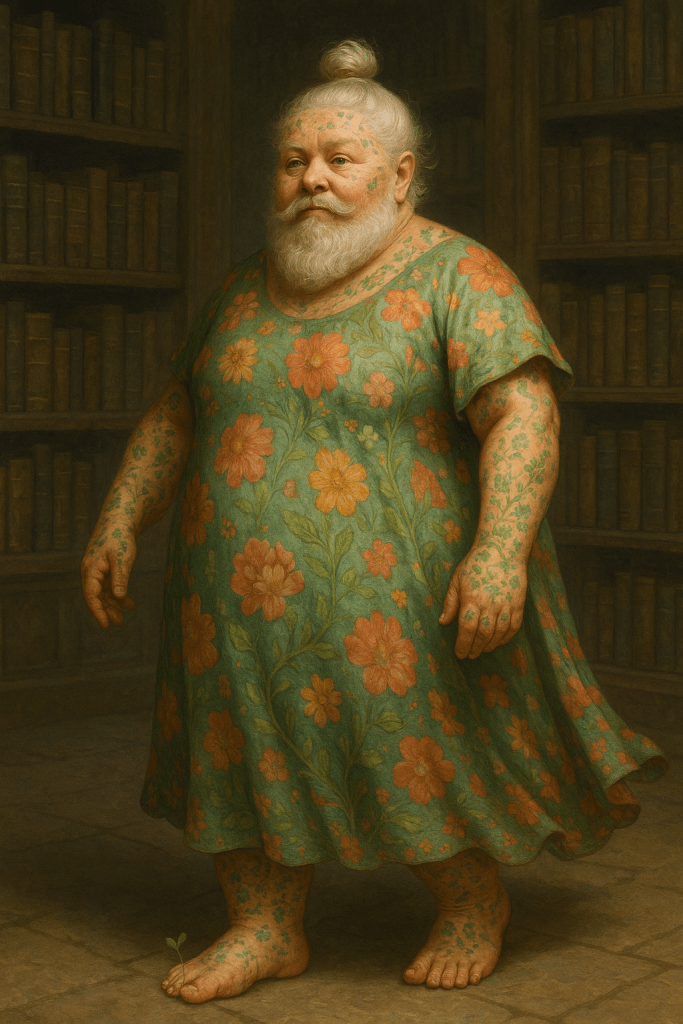
Gulgamill presides over it all.
Short, impossibly round, and barefoot no matter the season, she moves through the sanctuary with surprising grace, never disturbing a shelf nor knocking a corner. Her muumuu—brightly floral and ever-changing—trails softly behind her, and the tiny flower tattoos that cover her visible skin give the impression that she has been cultivated as much as born. Her beard is trimmed with obsessive care. A faint sprout sometimes emerges from the cracked skin of her toe, as if the soil of the world has claimed her. No one has seen her eat anything but the same daily delivery of reeking cheese and the jar of shriveled prunes she offers visitors in place of any purchase.
People come to browse. Few leave with books.
Even if you find a title—some rare alchemical treatise or a hand-copied ledger of a dead god’s dreams—you’ll be met with gentle resistance. Not through confrontation, but subtle redirection. She’ll recount the history of the copy, the brush that penned it, the creature that bled the ink, the lineage of those who held it before. By the end, even the most eager collector is unsure they’re worthy of ownership. She doesn’t hoard out of greed, but guardianship. Books, she believes, choose their readers. And most people simply aren’t chosen.
She covets cookbooks and foraging guides with particular affection. Dozens are preserved in glass cases or behind scented leathers, annotated in multiple hands, and some believed to be enchanted to resist fire or vermin. No one is sure why she favors these, considering her own diet is so unchanging and bleak. Perhaps it’s the artistry. Perhaps she simply likes to imagine a world where someone else still cooks with joy.
Despite the Sanctuary’s dense, immersive atmosphere, nothing is left to chance. Each lamp is placed for optimal preservation of spines. Each shelf aligned to avoid sun-bleaching. Even the air feels curated, rich with tannins and faint herbal traces that ward against mildew. And yet… the scent of cheese and prune syrup clings with tenacity, stubbornly defying the otherwise reverent ambiance.
There are rumors, of course. That Gulgamill is part dwarf, part dread-being, some ancient thing who wandered into the city centuries ago and decided to stop. No one recalls a time without her. No one has seen her leave. The cheese arrives, and the farmer vanishes again. The prunes never diminish. And the books—ah, the books—some say they murmur at night, pages whispering in tongues older than trade.
This is not a shop for the impatient. It is not a shop for the careless. It is a sanctuary—for the lost, the written, the beloved.
 Shermans fantasy world