Conclave in the Shadow of the SpireThe Argent Spire, Auris , Sanctuary of the Platinum Flame
A pall of incense hung thick in the vaulted chamber, the scent of myrrh and dragonflower clinging to the air like ghosts of prayer. Pale light lanced through the high stained-glass windows, Bahamut triumphant, Bahamut merciful, Bahamut as Judge of Kings. But the light was broken now, fractured by dust and disquiet.
Lady Gavashoon stood before the Inner Conclave, clad not in the mourning black of a royal widow, but in the argent and sapphire robes of a defender of the realm. Her eyes, stern and unflinching, bore into each of the assembled prelates as the doors sealed behind her with a sonorous echo.
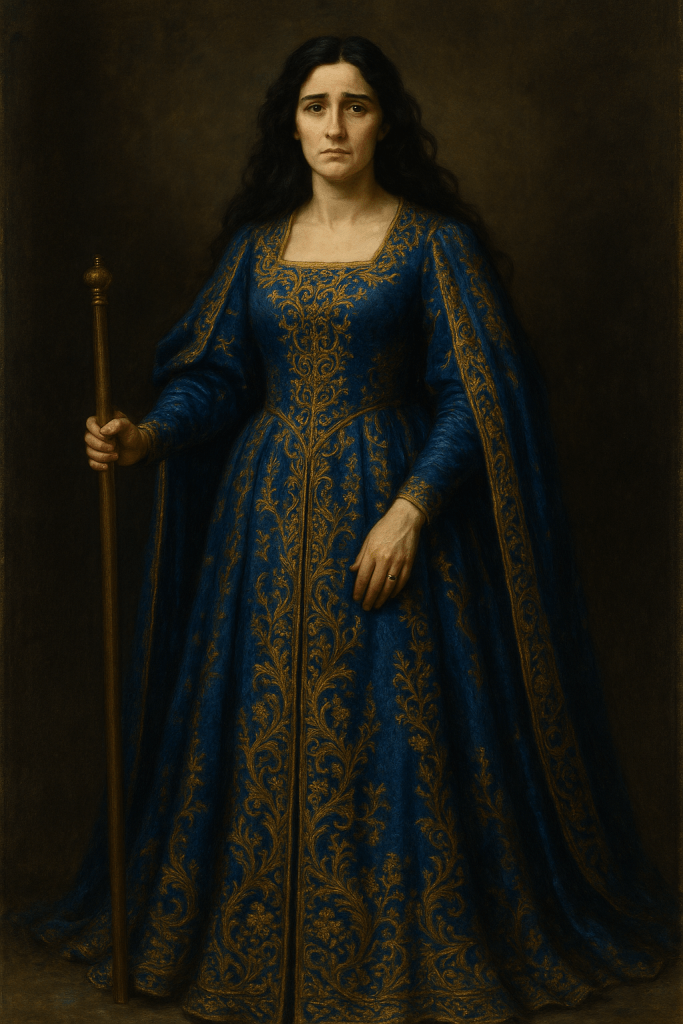
Upon the curved dais, seated in gilded thrones beneath the platinum sigil of the god, sat three of the highest remaining voices of the Church, each bearing weight enough to counterbalance even High Chancellor Thael.

Chancellor Ingris Mavrenn, the Sword of Mercy, a silver-haired woman whose sermons once turned brigands into brothers. Her voice could quiet riots.
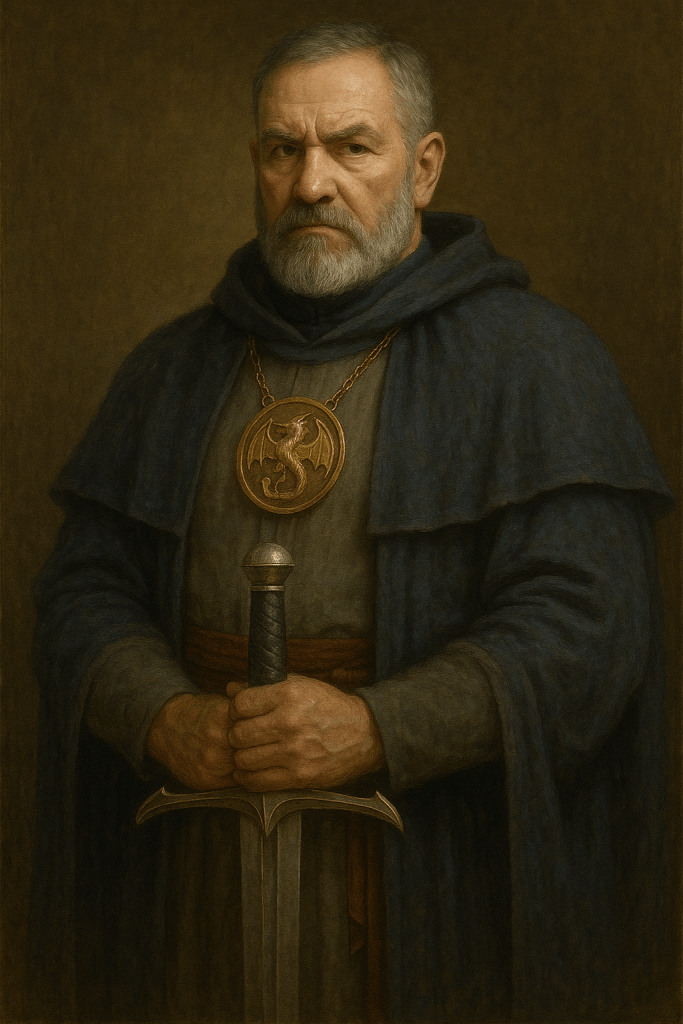
Archclaviger Tol Shendan, the Keeper of the Oath Flame, a barrel-chested, priest known for tradition and law, his hair dulled with age but his gaze still sharp as razors.
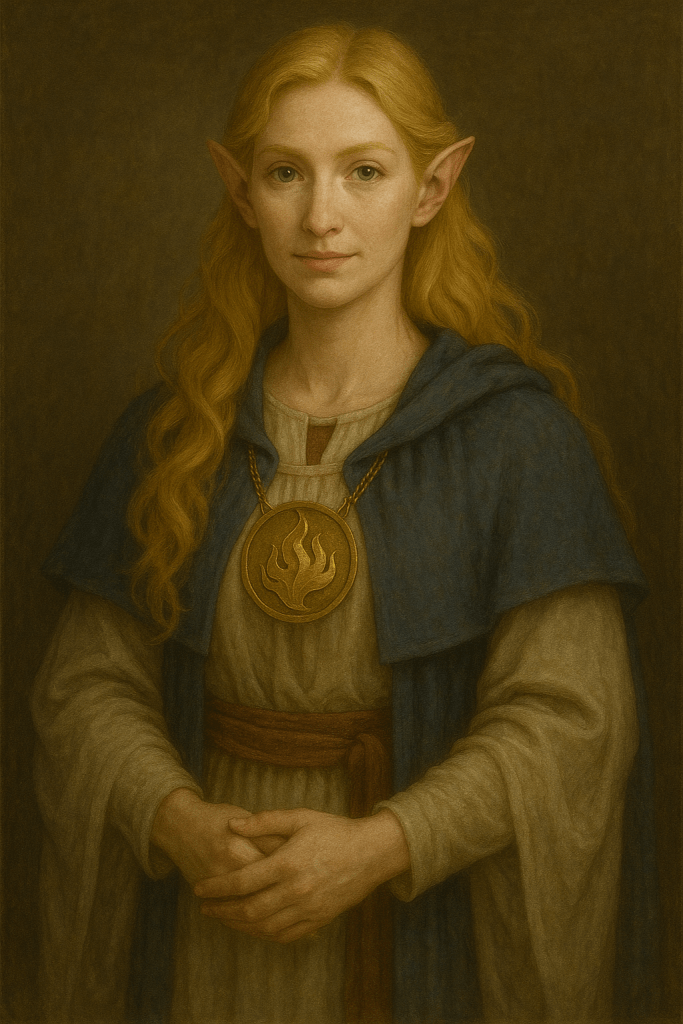
Dawnmother Celendra Ilistae, the Flame of Compassion, an elven matron whose healing miracles were legend. Her very presence was balm to wounded hearts.
They listened in uneasy silence as Lady Gavashoon stepped forward.
“I come not with demands,” she said, voice strong but tempered with grief. “But with the burden of a broken people, and the echo of a king’s dying oath. We made a promise, to the gods and to the suffering peoples, that Auris would not shut its gates to the desperate. Now, Vauran Thael preaches damnation cloaked in doctrine, twists Bahamut’s words into shackles for the weak. This is not mercy. This is not justice.”
The chamber was still. A shaft of light illuminated the mural behind her, Bahamut shielding the lowly with his wings.
Tol Shendan rumbled, his voice rough like gravel:
“High Chancellor Thael is the Voice of the Three Pillars. His words carry the weight of canon. If he sees danger in this influx, ”
“Danger?” Gavashoon cut in, her voice sharp. “We speak of widows, children, the crippled. And those who fought beside our own. They are not the enemy. Thael poisons the altar. He casts refugees as dragons in disguise.”
Ingris Mavrenn stirred, her fingers tight around the hilt of the ceremonial blade she wore even within temple walls.
“I have heard whispers. Fire in the sermons. He speaks of purity, of a ‘divine order’ that excludes those who ‘dilute the blood of Auris.’ These are not words of the Platinum Dragon. They are the words of tyrants and false prophets.”
Dawnmother Celendra, gentle yet grave, added:
“Worse still, I’ve been denied access to the refugee sickhouses near the harbor. Guards loyal to Thael. ‘Quarantine orders,’ they say. But I smell fear, and fear weaponized.”
Lady Gavashoon stepped closer, her hand laid reverently on the base of the Spire’s altar.
“You each know the Writ of the Pillars. Justice without cruelty. Mercy without hesitation. Shelter to the innocent, no matter their origin. If the Chancellor now teaches otherwise, then he no longer speaks with Bahamut’s voice.”
A beat of silence. Then, a clamor. The bells of the lower Spire began to toll. Interrupting. Urgent.
A robed aide burst into the chamber’s threshold, pale with dread.
“My lords, my ladies, there is an assembly outside the Argent Gate. Thousands gathered. The High Chancellor speaks even now upon the Granite Steps. And, Her Highness, Lady Gavashoon, is named by him in the sermon… as a deceiver, a dragon’s pawn, a widow unworthy of her husband’s legacy.”
The room spun with outrage and stunned gasps.
Tol Shendan growled:
“He dares issue anathema without conclave consensus?”
Lady Gavashoon turned, composed despite the betrayal.
“Then let us descend. Let us hear him, together. And if his words profane the faith we serve, then let us speak with one voice, before the people and the god who watches.”
Mavrenn, now rising from her throne, spoke firmly:
“I will not let Bahamut’s name be twisted into a sword against the helpless. If this be heresy, then let it be his, not ours.”
The three leaders looked to one another, and nodded.
As the doors opened again and they stepped into the gathering storm, the bells of the Spire rang louder still.
The Shattering of the Platinum Voice
Granite Steps of the Argent Spire, Auris
The square before the Argent Spire was swollen with bodies, thousands packed tight in reverent silence, faces turned up toward the marble pulpit set high above them. The banners of Bahamut snapped in the wind, but there was no comfort in their flutter now. The man who stood beneath them was no beacon of mercy.

High Chancellor Vauran Thael, resplendent in platinum-trimmed vestments rarely seen outside coronations, thrust one hand to the sky and the other toward the gates of the city.
“The rot is within! The serpents wear sorrow as disguise! The bleeding of our nation must end!” His voice, strengthened by magic, echoed across the stones. “We open our gates to those who bring famine, plague, and poison! The very ones our king gave his life for now come to feast on his bones, and the bones of your children!”
Murmurs of unease rippled, but he pressed on, eyes wild.
“And she, she who dares call herself queen, kneels to them! Welcomes them! She would rather fill our courts with beggars than defend our birthright! Do you not see it? She has betrayed Bahamut’s law!”
But then, a sound like thunder rolled across the square.
Bells. The bells of the Argent Spire.
From the inner sanctum, the great brass gates opened with a groan that silenced the mob. Down the long processional steps came Lady Gavashoon, veiled in platinum-threaded blue, flanked by Chancellor Ingris Mavrenn, Archclaviger Tol Shendan, and Dawnmother Celendra Ilistae, each bearing the sacred relics of their office. Their presence was a hammerstroke, a statement more potent than any proclamation.
Thael faltered mid-sentence.
The crowd shifted, confused. These were no petty clergy. These were the pillars.
Lady Gavashoon’s voice rang out, not magically amplified, but it carried all the same.
“Your Voice has cracked, Chancellor. You dare speak with the authority of Bahamut, but your words drip venom, not virtue.”
Tol Shendan’s staff struck the stone with a flare of golden fire.
“By the ancient rites, we contest your claim. You name yourself the Platinum Voice, but your tongue has become a blade turned inward. Bahamut’s will is justice. Not wrath.”
Mavrenn’s blade shimmered in the sunlight, unsheathed in ceremonial defiance.
“You have perverted the Writs. You have turned a god of shelter into a symbol of fear. We name your words false doctrine, your deeds, blasphemy. You will answer.”
The crowd roared, not in anger, but confusion, rising doubt. Farmers, guards, nobles, the devout, all looked between the Platinum-cloaked figure and the three venerable leaders they had known all their lives. The crowd’s faith tilted like a ship in a rising gale.
Thael’s lips curled into a sneer.
“You would lecture me? You, who coddle weakness? You, who would let dragons sleep beside our children? You are relics. Dust in robes.”
He raised a hand to call on divine light, but none came. His power, so often unquestioned, faltered in the face of righteous unity.
Then something in his gaze shifted, panic beneath pride.
The murmurs below became open doubt. Cries of “Let her speak!” and “Where is the mercy?” and “This is not the Bahamut I know!” rose like storm winds.
Then it happened.
The illusion broke.
To those watching closely, his robes flickered, not Platinum, but black beneath. The symbol of the Three Pillars warped into a fang-lined spiral. A shudder of wrongness passed through the air.
And in the blink of an eye, the Thael they knew was gone.
No burst of light. No thunder. melted away like frost in the sun, absence without a trace.
His vestments drifted, empty, onto the marble dais like shed skin. A hollow horrified hush fell over the square.
Lady Gavashoon slowly ascended the final step and lifted the discarded robe, holding it up for the people to see.
“The Voice of Bahamut does not flee. It stands. It protects. It does not wear shadows to speak lies.”
The people bowed their heads. Some wept. Others stared, stunned.
Behind her, Tol Shendan muttered low enough for only those nearest to hear:
“This was no crisis of pride. Something deeper has nested in our Spire.”
And Ingris added, hand tight on her blade:
“Then we will smoke it out. With truth.”
Oath on the Argent Steps
The Argent Spire, Auris – The Seventh Day of Mourning
The wind tugged at Lady Gavashoon’s robes as she stood where Thael had vanished, the hem of her mantle brushing the discarded vestments that had cloaked his treachery. Behind her rose the marble grandeur of the Spire; before her, the breathless multitude of Auris’s faithful, all eyes turned toward her.
She raised her right hand, palm toward the heavens, and her voice rose like a clarion bell, unwavering and fierce.
“By the Platinum Flame, by the Three Pillars, and by the breath of Bahamut himself, I swear before all gathered and all unseen that I shall not turn from the path of Justice. I will shield the innocent, uplift the fallen, and scour corruption wherever it festers. Auris shall not fall, not to war, not to fear, not to the whispering rot in our midst. So I swear, so I bind myself. Let Bahamut judge me if I falter.”
A silence fell, deep and reverent.
Then came the sound of three relics striking stone in unison.
Chancellor Mavrenn stepped forward first, drawing her silver blade and planting it tip-down into the dais.
“Let it be known, by right of the Writ and voice of the faithful, that we affirm and reaffirm Queen Gavashoon, sovereign steward of Auris, chosen in this dark hour not by blood but by purpose.”
Archclaviger Tol Shendan lowered his staff, which burned briefly with radiant gold as he spoke:
“Let the Conclave stand united. The Voice is shattered, but the Faith remains. We will select a new High Chancellor before the week’s bells end, and not one who hides behind masks.”
Dawnmother Celendra lifted her lantern, its soft glow spreading through the crowd:
“Bahamut’s light cannot be extinguished. Let his justice flow once more through the land. Let mercy rise with the morning sun.”
And the people, grieving, shaken, but seeing for the first time in weeks the face of strength untainted, cheered.
Hope, fragile and defiant, kindled like flame beneath frost.
The Rot Unearthed
Two Days Later – High Chancellor’s Chambers, Inner Sanctum
They found him lying on the floor.
Lord Vauran Thael, the real one, dead for nearly a fortnight, his body perfectly preserved by foul magic. His face was serene, hands crossed in ritual repose, untouched by violence. He had died in silence, and something had worn his shape like a vestment.
The conclave gathered in horror.
Auguries wept blood. Divination yielded no clear answers. A great distortion clouded the past, cloaked in shadows neither divine nor infernal.
A royal proclamation was issued within the hour:
“The late Lord Thael has been exonerated of all crimes. He was murdered and replaced by an unknown force of deceit and darkness. Let no blame stain his name. Let the hunt begin for the thing that wore him.”
The city of Vaelstrom, capital of Auris, transformed overnight.
Edicts were issued condemning the false teachings spread during Thael’s impersonation.
Wardings and arcane barriers were raised across government offices, temples, and noble halls.
Magical detection teams worked side by side with inquisitors and royal scouts. No spell was too obscure. No ally too unquestioned.
And still… fear.
Was it the Tal-Shie, masters of flesh and illusion?
Was it Innarlith, whose Dragon Queen had not yet revealed her full hand?
Or something older, a whisper from the war that had never truly ended?
The Watchful Silence
Auris held its breath.
Queen Gavashoon worked tirelessly, her council expanded to include trusted mages, diviners, and paladins of the Platinum Flame. She gave daily addresses from the Spire’s balcony, not to soothe, but to stand visible and defiant.
Her final words on the fifth day became etched into the minds of all:
“We do not fear the darkness. We hunt it. And we will not let it hollow this nation while we live.”
Across cities, towns, and borderlands, the faithful began to watch. Eyes turned inward as well as outward.
Because the enemy wore a man’s skin once.
And may again.
Eyes of Auris, Eyes of the World
Third Week of Vigil, Argent Spire – Auris
The missives flew fast, sealed with platinum wax, borne on swift hawks and teleporting circles to the seats of power across the fractured world.
To Taurdain, battered and bleeding but still sovereign, Queen Gavashoon sent warning and solace both. Despite their grief, they had weathered worse. She implored their leaders, such as they were in this time of broken banners and shattered thrones, to watch for shadows with familiar faces. “Beware those whose eyes remember what their tongues forget.”
To Mithrin, the great nation of many people, she sent a sterner missive, less a plea, more a charge. “Guard your courts. Test your servants. If they falter in detail or seem unmoored from memory, you must root them out. There is no shame in vigilance.”
To the ancient halls of Kadathe’, high and frozen in the crystal mountains of the north, her messages bore deepest fruit.
The return note came not from the king of Kadathe’ nor his martial hand, but from the Archivists of Talismonde’, a white-walled city of learning where winters are long and memories longer.
Their response came with reverent gravity.
“We have known of such beings. They are not mere shapeshifters. They are invaders of trust. They are Choulcalgan, the Many-Cloaked, agents of Kalliit before the First Sundering. They wear form, yes, but also intent. Some do not even know they are not who they seem until the moment of collapse. Worse still, some mimic the dead, wearing the face of loss like a weapon.
In our records we also mark the Wolf-Were, a solitary beast of chaos and blood. Not a creature of states, but one who delights in unraveling bonds through cunning and provocation.
And of course, the Doppelganger, whose flesh is mutable but whose will is mercenary, rare, yes, but not mythical. Often seen in service to rogue states, cults, or crowned assassins.”
These records were not unknown to Auris’s scholars, but what was new was the mention of the Choulcalgan appearing before the Great War, agents of Kalliit, that distant and shattered empire across the sea.
But Kalliit was ruin now. A place of fire and blighted skies. Unlikely. And too far.
No. The Dragon Queen.
Whispers turned to theories, and theories to wary consensus. Kraglann, the cursed warlock-engineer of the dreadnought The Hag, had told stories, hushed and bitter, of prisoners tormented by mirrors made flesh, dead kin made real to break the will of heroes.
If true, it meant the Queen of Innarlith was changing tactics. No longer domination by claw and pyre, but through lies and masks.
It was a new kind of war.
The Conclave Reconvenes
“Then she has learned restraint,” muttered Tol Shendan, closing the Kadathe’ scroll with a snap.
“Which is far more dangerous than her fire.”
They met in the sanctum beneath the Argent Spire, the Flame-Mirror Hall, warded against scrying and breach. The three Pillars sat with Queen Gavashoon, joined by mage-priests, veteran inquisitors, and a grim-faced dwarven diviner from the Deep Chapel.
Augur-Archon Vell Orvannis traced runes of piercing sight into a basin of liquid silver. The name “Dragon Queen of Innarlith” was whispered across the surface. For a moment, nothing moved.
Then,
A single scale floated to the surface. Black. Iridescent. Cracked at the edge, as if flaking from a dying flame.
“It is not proof,” the Archon said, “but it is a thread. And she is now in the weave.”
Nation on Edge
Across Auris, measures were enacted:
Passcodes of memory, questions only true citizens would know, shared only between bonded families.
Sanctified mirrors installed in every noble estate, able to reveal glamers with a command word.
Eyes of Auris, a newly formed order of inquisitors and arcanists, tasked not with punishment but with certitude, Who are you, really?
The public response was somber, but supportive. They had seen what lies could do, how even faith itself could be twisted.
In villages and cities alike, families double-checked memories. Husbands asked wives questions of their first meeting. Children were taught secret phrases to test their elders. Not out of paranoia, out of solidarity. The nation would not be fooled again.
The Silence Before the Strike
And still the Dragon Queen made no move.
No proclamation. No army raised. No retaliation.
But watchers in the east began to whisper, long-haul ships in the Redreach Isles disappeared. A known lich-ally of Innarlith was seen, unburned, walking in the ruined cloisters of Kalliit. And refugees from the south, babbling and half-mad, told stories of mirrors that wept.
And so Queen Gavashoon stood ready.
Swordless, but unshaken.
The bells had not yet ended the week.
But war, it seemed, was not yet done with them.
A Kingdom at War
The Fourth Week of Vigil – Auris
“We do not know its name,” Gavashoon spoke to her council, voice low. “Only that it wears others. And that it lies better than we speak truth.”
The enemy was no longer an army, but an infection. There were no lines to draw, no fortresses to assail. Only shadows, and the creeping dread that those closest to you might not be who you remember.
The Enemy of Truth
What they faced now was a foe of deceit, subtle, cunning, and perhaps already seeded deep within every court and council.
Some said it was the Dragon Queen, using her changeling weapons again.
Others whispered of Kalliit, perhaps not as broken as it seemed.
A few even suggested a new power, one unnamed and ancient, one that could wear love like armor and slip through divine sight unseen.
What was known:
The false Thael had been powerful. Magically shielded, politically precise.
He had spoken not as a fanatic, but as if he believed, and perhaps he had.
The real body had been dead for weeks, untouched, preserved, surrounded by protective glyphs that had been disarmed from within.
Such power… was not mimicry alone. It was subversion.
Reinforcements of the Mind and Soul
In response, Auris initiated a spiritual lockdown. Every major temple now maintained not only magical defenses but truthwards and memoryseals.
Clerics of Bahamut retrained in soul rites, to detect changes in aura and divine signature.
High Inquisitors wore glyph-branded veils that could burn through illusions with a glance, though they burned the user too.
Trusted families shared Mnemonic Keys, memories locked together to test authenticity.
The hunt continued.
But no new traitors were found.
Which, in itself, was suspicious.
Gavashoon’s Response
In a speech broadcast through magical crystal to every city of Auris, Queen Gavashoon addressed the nation, not as a ruler, but as a bulwark.
“We face an enemy of lies, a foe of stolen faces. It is no longer war that challenges us, but truth itself.
We are not just a people of swords and shields. We are a people of love, of oath and honor.
That cannot be mimicked. That cannot be worn like a mask.”
And then she placed her hand on her heart and spoke the words that would become etched in the minds of a generation:
“If they wear our faces, let us remind them we remember more than flesh.
If they speak in our voices, let us answer with voices that do not tremble.
Let no shadow go unchecked. Let no silence go unchallenged.
Let no lie become law.”
What Comes Next
The nation waits, vigilant. But something stirs beneath:
Strange dreams begin to infect seers, dreams of mirrors, wolves, and open doors.
Reports surface of royal bloodlines falsified, family trees that contradict themselves.
A single glyph, unknown and not of any school, appears burned into an alley wall behind a Bahamut shrine. It glows only when no one looks directly at it.
An ancient Tal-Shie artifact, long inert, begins to hum softly in the Spire’s vault.
The war is not over.
It has simply changed shape.
Beneath the Crown, Beneath the Skin
Fifth Week of Vigil – Council Chamber of the Argent Spire
The chamber was dimmed against the high sun, curtains drawn and windows shuttered. Only the scrying mirror pulsed softly with muted light as three Seers of the Inner Eye knelt upon silver-threaded prayercloth, their foreheads beaded with sweat.
Before them stood Queen Gavashoon, flanked by the Triarchs of Bahamut’s Pillars and a half-dozen sworn inquisitors of the newly formed Order of the Veiled Flame.
No one spoke.
At last, the eldest seer, Ylvenna of the Third Sight, her eyes clouded milk-white with oracular cataracts, lifted her head.
“It points inward, my lady. Not east, not south. We cast again and again, and still the same constellation rises. The blood of the king stirs unrest. His brothers… we see their shadows over gold. Over legacy.”
A breath caught in the chamber.
Lord Harkan and Sir Vyrell, brothers of the late King Rhaedric, had long lived in the outer provinces, wealthy, titled, but content to remain distant from the capital’s heart. Or so it had been believed.
“No images,” murmured Ylvenna, “but whispers of plotting… coin moved in silence… servants speaking of men in cloaks too fine for the roads they claim to walk. They hide, but not as enemies. As family. That is the danger.”
Lady Gavashoon said nothing at first.
She studied the seers, the mirror, the slight tremor in Celendra’s hand. Then she turned, speaking to the full council, not in fear, but in careful command.
“Portents are signs, not proof. And we know the enemy wears masks. If we act in haste, we may bloody our own and do the enemy’s work for them.”
Her eyes turned to Archclaviger Tol Shendan, who gave a slow nod. He understood. Many in the crowd did.
“We will not shatter kinship for rumors. I have no love of doubt, but I have no mercy for false justice either.”
Then, more quietly:
“If it is true… if the king’s blood has turned treacherous… I will not look away. But we will not walk blindfolded into accusation. That path is strewn with blades.”
Covert Measures
That evening, the Eyes of Auris were activated in full. Trusted agents from among the paladin orders and court mages slipped silently into positions across Caldrith’s Reach, the western estate of Lord Harkan, and Glasswell Keep, where Sir Vyrell had taken up quiet residence after the king’s death.
No accusations. No flags raised. But:
Trade records were reviewed.
Old household servants were questioned, indirectly, carefully.
Messages were intercepted, traced through mundane couriers and arcane alike.
And in the deep archives of the royal ledgers, a new document surfaced: a sealed inheritance clause authored by King Rhaedric himself, naming Lady Gavashoon sole steward of the Aurian Treasury in the event of his death. A clause neither brother had ever publicly acknowledged.
It was circumstantial. But together, the pieces whispered intent.
And that was more than the Dragon Queen had given.
The Queen ’s Inner Circle
That night, alone in the Chamber of Blue Flame, Lady Gavashoon confided to her closest aides:
“I do not want it to be them. But if it is… then I will answer it, not as widow, not as Queen , but as the sword of justice this nation needs.”
A pause.
“And if it is not them, then someone wants us to believe it is. Which may be the more dangerous truth.”
Her gaze lingered on the flickering flame before her.
“Lies dressed in family. What cruelty.”
The Quiet Order
Sixth Week of Vigil – The Vaulted Halls of Silence, Argent Spire
“This is not a matter for our allies,” Gavashoon had said, her voice measured but iron-edged. “Seal them from this work. Let them trust us when it is done.”
The order was given in secret, with no announcement, no written record. Only the Triarchs, the Veiled Flame, and the Queen ’s most trusted inquisitors knew the scope of the new directive.
For all the signs, the king’s brothers remained untouched by guilt. Their dealings mundane. Their accounts in order. Their correspondence loyal, even grief-stricken. Harkan had donated three barges of grain to Taurdain’s rebuilding efforts. Vyrell had funded the reconstruction of a school in memory of the late king. All gestures of fidelity. All precisely the things a guilty man might not do.
But the auguries had screamed their names. Again. And again.
“Too loud,” whispered Dawnmother Celendra. “Too clearly. When divination becomes absolute, it ceases to be true.”
Suspicion shifted.
It was not the brothers.
It was the vision itself that had been twisted.
Tal-Shie: Binders of Thought, Warpers of Will
There was precedent. Fragmentary records from the Battle of Farsoul, recovered only a generation ago, spoke of Tal-Shie ensorcellments, spells not meant to blind or kill, but to bend perception, to corrode trust, to place false thoughts in minds not their own.
Memory binding. Will leaching. The muddying of truth itself.
The Tal-Shie had warred with Kalliit for a century, but it was not the sword that made them dangerous. It was the echo of them. The artifacts they left behind.
And now, perhaps, one of those echoes was singing again.
The Hunt for Forgotten Wounds
“If prophecy lies,” said Tol Shendan, “then something older than our magic is in play.”
A new directive was issued in the name of the Queen and the Pillars:
Every recovered Tal-Shie artifact, relic, shard, or scrap of metal seized during the war would be brought to the Spire, or sealed beneath watch in the Vault-Crypts of Auris. Anything with a trace of enchantment, unclear origin, or prolonged mental influence was to be submitted for inspection.
The work began immediately.
- In the northern libraries, faded scrolls in elemental script were removed from circulation, their glyphs sometimes shifting when unobserved.
- In the Museum of the Burned War, a glass rod retrieved from Tal-Shie trenches was found to emit auras that defied school or source.
- One noble family, proudly displaying a Tal-Shie sunstone orb above their hearth for three generations, now found themselves plagued by waking dreams and mirror voices.
Every item touched by the Tal-Shie weave, every item too long unquestioned, was now suspect.
A central repository was established deep beneath the Argent Spire, overseen by Archivist Raal Vintren, the most unyielding arcane mind Auris had left. His eyes were pale as parchment, his wards older than the war itself. He welcomed the task with only one sentence:
“If something is singing through these relics, I will silence it.”
Meanwhile, in the Quiet Places
Though the people were not told the details, they could feel it.
Clerics began wearing talismans of steel and bone, carved with the old sigils of truth and memory.
Some mages began forgetting recent spells, or recalling events from years ago that never happened.
In the lowlands, a shepherd was found whispering in the Tal-Shie tongue, though she had never learned a word of it.
And in the Queen ’s private sanctum, one of the seers, the youngest, a boy barely past fifteen, confessed a final vision before falling into an exhausted sleep:
“It’s not a face… it’s a voice… not false, just older than memory.
It sings inside the oldest things.”
And Still She Watches
Lady Gavashoon remained calm, yet colder than before.
Not withdrawn, but sharpened.
She began keeping a journal, written in three separate scripts, and burned each copy every morning.
She now ate only meals prepared by her own hand. Met visitors in mirrored chambers.
And every night, before lighting her lantern, she whispered the same phrase to herself in the tongue of Bahamut:
“Justice is not swift. Justice is sure.”
The Root Beneath the Altar
Seventh Week of Vigil – Beneath the Great Sermon Hall, The Argent Spire
In the days before the horror was unveiled, the investigators scoured every corner of the Lord’s old chambers and the church, employing scrying and detection spells. Despite their efforts, they found nothing substantial. The artifacts were otherworldly and unsettling, but none seemed to cause the current situation. It was as if the true source was something unseen, something that didn’t reveal its nature. The search continued, focusing on the origins in the Lord’s chambers and the church, but days of searching yielded nothing. Then, in the depths of the church’s cistern, they discovered a horror beyond comprehension
It was not prophecy, nor interrogation, nor spellcraft that led them there, it was the smell.
A scent like wet parchment, old copper, and singed lavender, wafting from the forgotten sluices of the cistern vaults beneath the grand sermon hall. None remembered the last time those tunnels had been walked. Perhaps none ever should have.
The Eyes of Auris breached the sealed underpassage in the fourth hour of dawn, torches failing to cast proper light in the stagnant dark. The air pressed in with unnatural humidity, the stones slightly warm, as if something below breathed.
And then they saw it.
A mass, a quivering thing.
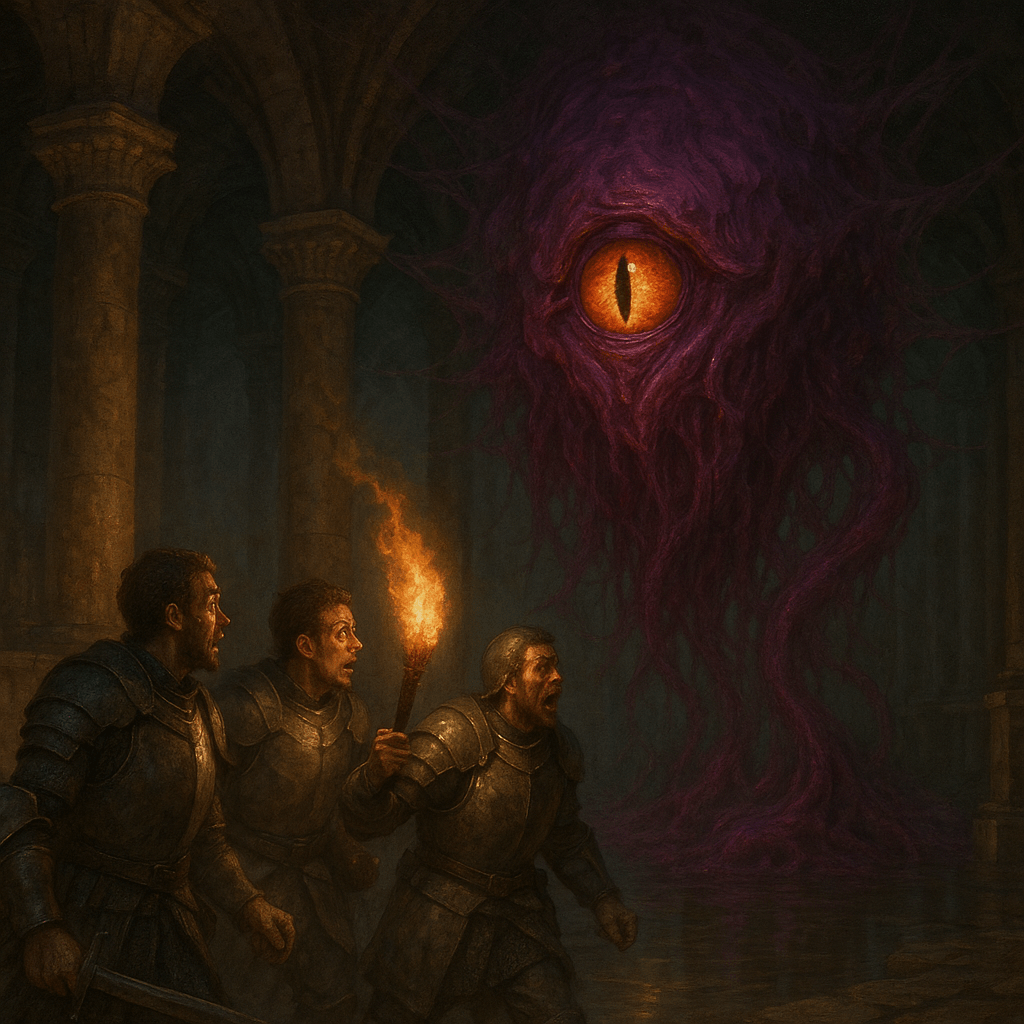
Pulsing, quivering, a thing like coagulated memory caught in a cocoon of webbed nerves and drifting vapors. It hung in the heart of the chamber like a blasphemy, suspended by filaments too perfect to be natural and too obscene to be crafted.
Not an Oblex, not entirely, though it bore the hallmarks. Threads of stolen thought, phantom voices on the air, pieces of speech trapped in endless loops.
But something else pulsed inside it, not merely memory, but agency.
A Mind.
It scraped the minds of the first watchers. One wept, and forgot her name.
Another turned his sword on his own shadow, babbling about his mother’s voice.
A third tried to speak a warning, and bit off his own tongue.
They fled upward, blind and reeling, and the doors to the cistern were sealed with seven layers of divine sigil and steel.
The Council of Shadows and Flesh
They met again that night, Queen Gavashoon, the Triarchs, the Grand Inquisitor of the Veiled Flame, and five of the most trusted arcane minds in the nation. The chamber was silent but for the crackle of wards.
“It is alive,” whispered Archmage Kelrend Morith, his face pale and wet with a nervous sweat. “And it feeds. Not just on thoughts, but on identity, memory, belief. That is why it twisted the auguries. Why it could not be found. It is not casting spells, it is rewriting minds.”
The Grand Inquisitor bowed his head, visibly shaken.
“We sent soldiers in. None returned whole. One is now mute, and dreams of a sky that has no sun. The other has taken to carving the names of people he claims never existed, into his own skin.”
Dawnmother Celendra could not speak. Her tears did instead.
Queen Gavashoon stood with her hands behind her back, gaze distant.
“It was beneath the sermon hall,” she said at last. “All this time… it listened. It learned. Perhaps it even whispered. Through Thael. Through others. We were not infiltrated. We were harvested.”
Archclaviger Tol Shendan rose, slamming his warstaff down.
“Then it must be burned. Seared. Unmade. It cannot be allowed to escape.”
But Kelrend shook his head.
“It is not so simple. If we destroy it directly, we may scatter it. Its mind is not in one place. It may have already seeded parts of itself into others. We must be surgical. Cautious. Or we risk everything.”
Options on the Table
The following options were weighed and debated:
- Containment and Starvation
- Ward the cistern with divine and anti-psionic runes.
- Prevent all sensory input, light, sound, magic, thought.
- Starve the creature of stimuli until it atrophies.
- Risk: It might already be outside, through a whisper, or a dream.
- Excision via Soulburner Rite
- An old, dangerous rite of Bahamut’s cleansing fire that burns through the soul tether of entities linked to other minds.
- Might destroy it entirely, but at the cost of every mind it has touched.
- Risk: Hundreds might die.
- Dreamborne Infiltration
- Send a lucid seer or psychic into the creature’s shared memory network while it sleeps.
- Map its mind. Sever it from the stolen pieces. Then strike.
- Risk: No one has ever returned sane from such a task.
- Call for Divine Judgment
- Bahamut’s direct intercession, an open summoning of divine presence at the risk of invoking judgment on all present, including the innocent.
- Last used in the Second Age.
- Risk: The god may see more than the enemy, and judge more than they wish.
Queen Gavashoon Speaks
She turned, calm amid the chaos.
“We will not rush. We will not burn truth to find a lie. But neither will we blink in the face of it.”
A pause.
“Seal the chamber. Strengthen the wards. Let none approach it who do not wear the Veil. And ready a dreamer, one of faith, one with steel in the soul.”
She turned toward the Flame Mirror, casting her own reflection back in the wavering glass.
“We face a liar made flesh. Then let us speak truth that cannot be stolen.”
The Quiet Wrath of Bahamut
Eighth Week of Vigil – Auris in Lockdown
It had a name now, not one they could speak aloud, but one they understood.
It was not just a beast. It was a mind-web, threaded through stolen memories and borrowed thoughts. It knew what others knew. It learned. It listened.
And so, Queen Gavashoon sealed the truth behind silence.
“No one who hunts it may know it whole,” she said. “Lest it hear our strategy before we act.”
The order spread not through proclamation but through ciphered script and sealed tongues. The church’s highest diviners and seers were tasked with a new mission:
Scry not upon the beast itself, but upon its echoes.
The Hunt for the Seeds Begins
The Augur’s Web, a high circle of seers warded in mirrored sanctums, began casting wide net scrying across the realm:
Searching for resonance: lingering echoes of the same mind-signature as the mass below the Spire.
Looking for those with fractured memories, looping speech, or emotional dissociation, signs of parasitic influence.
Watching for dreamers who spoke in voices not their own, especially those who had visited the Grand Sermon Hall in recent months.
The results came slowly, but they came.
Four suspects.
A humble scribe in the lower courts whose journals showed identical entries copied across five months with only the dates changed.
A child acolyte in the Temple of Judgment who, in dreams, spoke sermons that hadn’t been preached in fifty years, and in the exact voice of the long-dead priest.
A coinmaster who once served under Thael, who now claimed not to remember his own wife’s name but could quote ancient Tal-Shie glyph-verse.
And worst of all, a Knight of Bahamut, well-regarded, who had begun carving labyrinths into the stone of his quarters. Each matched the vein patterns of the mass in the vault.
Fire and Faith
The Knighthood of Bahamut, armed with this knowledge, was tasked with divine purgation. Not with malice. Not with cruelty. But with holy certainty.
“We do not slay our own,” said Knight-Marshal Drelhame, “unless they are no longer our own.”
Each of the suspects was approached in staggered intervals, by teams of three, all wearing Mirrored Masks of Truth, enchanted to reflect psionic influence and mimicry. These knights bore sanctified flamebrands, sheathed until confirmation.
In each case, once confronted, the results were immediate and horrific:
The scribe’s skin melted like wax, revealing a gelatinous mockery of his face, and shrieked in four voices at once before being silenced by holy flame.
The acolyte, upon waking, tried to flee, but her eyes turned black, her voice like grinding stone. She erupted into psychic noise before collapsing into a liquid smear of thought-stuff.
The coinmaster ignited on sight, his body housing a parasitic node that had already been weaving invisible glyphs across the gold vaults.
The Knight had not been turned. He had been marked. A latent seed coiled in his mind, but not active. He now stands under constant watch, locked in prayer and penance, begging the god for clarity.
The fires burned hot. None who were truly kin suffered.
The Vault Is Not Silent
Below the sermon hall, the thing stirs.
The wards flicker, briefly, subtly. Not enough to break. Not yet. But enough to be seen.
Every hour, three Knights rotate to the sealed seven-point gate. No one speaks at the threshold. No one lingers. Every sound, every change in air pressure, is recorded by a dwarven scribe who can neither hear nor see but feels tremors like a seer feels prophecy.
No one is permitted entry. Not even the Council.
A single phrase now governs the ward’s perimeter:
“Trust no face. Trust only flame.”
Gavashoon’s Vigil
The Queen no longer sleeps. She rests in meditation, guarded by no one, surrounded by glyph-bound steel mirrors, and writes now only in code.
Each night, she lights a single candle in the window of the Spire’s highest chamber and whispers:
“Bahamut, see us. In silence. In ash. In truth.”
Dreams Not His Own
The Ninth Week of Vigil – Bastion of the Shrouded Flame
Sir Alren Tareth, Knight-Vigilant of the Platinum Vow, had been marked by the mass, not consumed, not yet, but scarred within. Where others had been twisted into servants or slain outright, Alren had endured. But each night he slept, he wandered deeper into the enemy’s long, long mind.
He no longer spoke plainly. He wrote in mirrored script. He sometimes forgot who he was, but not what he had seen.
The Dreaming Begins
He dreamed of towers built from tendons, spiraling into black skies where stars blinked like eyes behind skin. He dreamed of lakes that whispered, not with water, but the sighs of dead thoughts.
But most often, he dreamed Tal-Shie death songs, not sung, but wept by burned mouths, each note unraveling his grip on self.
He spoke, one morning, softly:
“They caught it once. Not the Tal-Shie… no, no. The Kalliit. Gods curse them, but they were clever. I saw a city, it burned blue. Not flame. Memory. The creature writhed, then vanished. Like oil on glass in a sunbeam. It can die. It can be burned out. But not by steel.”
The augurers pressed him for clarity, piecing fragments from fractured recollection.
Distance is No Cure
They tried to move him. First to a fortress in the northern fens. Then to a floating sanctum above the Crystal Ridge. The dreams followed. Geography offered no reprieve.
“It’s not a parasite,” one augur whispered. “It’s a tether. He is tied to it… or worse, it to him. He is an echo chamber, a bell it rings to remember itself.”
“Or a beacon,” another offered grimly. “A second mind to hide inside, should the first be destroyed.”
They ringed him with salt, platinum dust, and flame, and he still dreamed. Each morning, another Tal-Shie phrase uttered in trance, none translatable, all disturbing.
Fragments of Insight
When dream augurers dove into his mind (protected by wards of mindsteel and divine sight), they saw glimpses, but only from one direction.
The Knight could not be shown the past directly, but he saw the creature’s reflections of it.
He saw three Kalliitian magi, bound in glyph-scorched robes, summoning a column of pale blue fire from a ring of blackened crystal. The mass screeched, a dozen memories torn loose from it, and burned into nothing.
He saw a glyph etched into gold, smeared with divine ichor, a blend of clerical faith and arcane law.
He saw one word, whispered by the creature as it fled, not screamed but mourned:
“Varnosh.”
“It was its name, once,” Alren muttered days later. “Before it became many.”
The name burned away on parchment when written. No spell could hold it. But the Knight remembered.
The Search for the Weapon
Sealed missives were sent to Talismonde’ under the strictest oaths. Only four known scholars of pre-War Tal-Shie-Kalliit relics were trusted to even see the queries.
Most responses were cryptic, but one came back with a sealed crest and a warning:
“There is mention of a city in Kalliit’s western empire, Yoreth-Cal, where forbidden rites merged divine and arcane flame. A cleansing fire not wrought by gods or men alone.
Only one page references it. All others burned in the Sundering. But they called it:
Aethr-Fire.
Not summoned. Not made. Bound.
To use it would cost dearly. But it left no shadow behind.”
No record of this flame remains in Auris. No known practitioner survives. But now… they have a name. And the creature has one, too.
Gavashoon’s Decision
Upon hearing the fragments, the Queen stood long in silence. Then:
“We have its mark. We have its wound.
Now we must find its death.
Begin the search for Yoreth-Cal’s survivors. Quietly. Ask of the flame.
If we must burn the beast’s mind, then let it be a fire that leaves nothing behind.”
She turned to the Knights of the Flame.
“Sir Alren is no longer a soldier. He is a tether. If he begins to slip beyond our reach, I leave it to your judgment.
But should he survive… he may be our lantern in the dark.”
The Shadow Eternal
The Tenth Week of Vigil – Auris, Kadathe’, and Beyond
The augurs and dream-divers of Auris have only begun to understand the shape of Varnosh, the memory-mass, the soul-slime, the one who remembers in order to exist.
“We thought it fed on thought,” said Archmage Kelrend, eyes hollow. “But no… it feeds on being known. It is not memory alone, it is identity parasitized. It lives as long as it is remembered.”
And worse… it remembers itself.
Like a loop. A coil. A recursion.
“Varnosh,” said the dreaming knight, “was not always a horror. It was made so, torn from a godlike mind, before the Sundering.
A dream fragment left to fester. And it does not fear fire. It fears being forgotten.”
The Yoreth-Cal Doctrine
The broken records from Talismonde’ speak of a final act in the fall of Yoreth-Cal.
There, cornered and crumbling, three Kalliitian magi and a priest of the Bastion God bound their own soul-threads, memories, and divine conduits into a single inferno, the Aethr-Fire.
“It did not burn flesh,” the scroll read. “It burned connection. Thought-web. Echo-soul. Anything tethered across minds or weave or time.
The caster forgot how to speak afterward. The priest went blind. The third… we do not know. But the slime was gone, and did not return.”
To recreate it would require:
A divine soul, willing to burn its own link to the gods.
An arcane anchor tied to a fixed weave-thread.
And a memory-seal, offered willingly by one who knows the creature’s name.
Queen Gavashoon whispered, “That would mean Alren.”
Aethr-Fire or Eternity
So they prepared.
Gavashoon consulted the Triarchs to determine who would give up their link to Bahamut.
Magebound archivists scoured every known Tal-Shie ruin for arcane anchors still alive in the Weave.
And Alren Tareth, the Knight Dreamer, was offered the choice. He answered with one phrase:
“If I forget it… and it forgets me… then let me be the lantern that flickers out.”
But Varnosh Planned for This
In a chilling moment during one of Alren’s seizures, the dream-divers heard a whisper not from him, but through him:
“I live in the cracks. In the forgotten corners. In the memory of those long dead. I knew the world when it had no sky. You cannot forget what remembers itself.”
And they knew then, it had more than one tether.
The Tendrils Beyond
In the waking world, reports arrived from Mithrin: A bard known for perfect recollection forgot his own songs, but could quote strangers’ dreams.
In the Salt Marshes of Vaerre, a merchant who never left the coast spoke fluent Tal-Shie in her sleep.
In Kadathe’, one of the frozen archivists of Talismonde’, preserved for centuries in still-life magical stasis, blinked. And wept.
“It left pieces of itself behind,” Gavashoon said. “Seeded into minds. Books. Artifacts. Not alive. But dormant. Each could grow a new Varnosh in time.”
Even if they destroyed the creature in Auris, they would have to silence its echoes. Everywhere. Or it would begin again.
The Magebane Proposal
It was Archmage Kelrend who, in desperation, made the suggestion:
“We do not need to kill it. We need to devour it.”
He spoke of a creature lost to time, mentioned in Kadathe’ grimoires dating back to the Everwinter War:
The Magebane.
Carapaced, cyclopian-eyed, crustacean-like, anti-magical and utterly alien.
It did not just eat spells, it devoured the memory of magic from casters’ minds.
In one case, it left a wizard alive, but unable to recall how to summon fire, or even what fire was.
“If it could feed on the mind-threads Varnosh has scattered, if it could consume the very memory of it, then Varnosh could not remember itself.”
“And a thing that forgets itself,” said Celendra softly, “dies.”
The Last Hope: Kadathe’
Urgent dispatches were sent to Kadathe’, this time in desperation. The Queen ’s own seal bore a single phrase:
“Not flame. Not blade. But forgetting.”
And Talismonde’ responded within hours.
“One specimen remains. Barely alive. Bound in layers of nullstone and soulsteel.
Its hunger is insatiable. Its presence… dangerous.
It has not fed in centuries. It may kill what it touches.
But it may be what you seek.”
And Now They Choose
- Aethrfire, a ritual of suicidal unmaking that may purge the beast… at the cost of those casting it.
- Or the Magebane, a creature that may not only consume Varnosh’s threads, but those of the innocent as well. If loosed, it might eat too far. Too deep.
Either is a weapon against the entity.
Neither can be wielded without sacrifice.
And Varnosh… it sleeps still.
But it smiles in dreams.
The Magebane Accord
Tenth Week of Vigil – From Talismonde’ to Auris
The response from Kadathe’ was swift, and heavy with warnings:
“We will grant the Magebane. We believe it offers your nation hope.
But know this, it is not a weapon. It is a hunger.
It will not obey. It does not understand ally or enemy. It simply devours magic, and the memory of it.
It fears divine essence. Use this sparingly, or risk driving it mad.
The last time it was fed, it tripled in size within minutes.”
Nature of the Beast
The Magebane is neither arcane nor divine, it is null, anathema to the Weave, existing in violation of magic itself. Resembling a crab-like construct of pale carapace, silver chitin, and pulsing organ-sacs, its nature is simple:
It devours arcane energy at the source, not just spells, but conceptual understanding.
Divine magic repels and even injures it, though only specific abjuration and purification rites have proven effective.
It cannot fly, teleport, or breach wards by spell, only by proximity and attrition.
If it feeds well, it may grow to a size exceeding the cistern, rupturing containment.
The Magebane’s Prey: Arcane or Divine?
The being known as Varnosh is a hybrid, born of arcane unraveling, but mutated through shared minds, faith-haunted souls, and divine memories. Yet its core tethering is arcane.
It builds its web of self on the Weave, it threads minds together using a corrupted version of Thoughtform Magic, an ancient Kalliitian discipline.
Thus, the Magebane can feed, and likely kill, the entity.
But:
If the creature’s divine residue resists too strongly, the Magebane might falter or be repelled.
If the Magebane feeds too deeply, it could rupture the vaults, uncontrolled and immense.
The Strategy
- Transport & Awakening
- The Magebane arrives bound in nullstone sarcophagi, sealed by eight abjuration locks.
- It is kept sedated using a slow-drip of radiant motes, divine particulate dust known to suppress magical appetite.
- Upon arrival in Auris, the creature is kept underground, far from any spellcasters or enchanted items.
- Containment Measures
- The cistern is reinforced with circular divine wards, to protect the Magebane from touching holy anchors and triggering panic.
- The Magebane is to be funneled toward Varnosh’s chamber via a warded gauntlet, a controlled descent to its target.
- Divine paladins of Bahamut stand ready with pacification rites (listed below) should it breach control.
- Emergency Response
- Knights of Bahamut are stationed with glyph-branded flameblades and abjuration seals to strike down or contain the Magebane should it lash out or attempt to flee.
- Should it fail, the Aethr-Fire circle is to be triggered remotely, already built and waiting in the chamber directly above the mass.
Divine Magics to Subdue the Magebane
Only divine spells or effects can deter the Magebane. The following are believed effective, as compiled by Talismonde’ scholars and Aurian theologians:
Sanctified RestraintAnchors a creature of null or alien origin in a zone of divine stillness.
- Halts movement, suppresses feeding instincts for 1 minute per caster level.
- Must be cast from outside the Magebane’s nullfield or it will fail.
- Rarely known, only high priests of Bahamut, Tyr, or Celestian have mastered it.
Final Orders
Queen Gavashoon gathered the inner council in a sealed chamber and gave her decision:
“We will try the Magebane. We will watch it feed. If it begins to bloat beyond the stone, we end it.
If it flees, pursue it to the edge of the world.
And if it falters before the beast… then we light the flame.”
Then, quieter:
“Let this be the end of it. Let us never speak its name again. Let the world forget Varnosh…
even if we must burn ourselves to make it so.”
The Saviour We Must Unleash
The Eleventh Week of Vigil – The Vaulted Depths Below the Sermon Hall
It squatted in silence, twitching.
The Magebane, they called it, a name whispered in old Kadathe’ texts with as much reverence as revulsion. Bound in six layers of nullsteel and warded with radiant dust, it had not moved since its arrival.
Until now.
It sat on the stone like a bloated shorecrab, its pale carapace gleaming with oily luster. It had no face, no expression, only a single, cyclopean eye, a pit of void so deep it seemed to drink the lanternlight. Its claws, jagged and interlocking, twitched as if sensing the ocean of magic beneath the floor.
“This… is our saviour?” whispered Dawnmother Celendra, her hands trembling in her sleeves. “It looks as though it should be stepped on. And yet…”
She trailed off, unable to look at it too long. The eye was a depth the soul feared.
“It fed once,” murmured Archmage Kelrend, “on a mere sorcerer’s vault and three conjurers. And it swelled to the size of a wagon. That… below…”
He gestured to the sealed stone beneath their feet.
“That thing is made of magic, woven into minds. If the Magebane devours it whole…”
There was silence.
“How large will it become?” someone whispered. “Will the Spire even hold?”
Above, the Aethr-Fire Waits
In the sermon hall above, warded and consecrated, the Aethr-Fire ritual circle was complete.
An arc of broken memory-glyphs, infused with divine ichor, coiled like a serpent around the brass inlays of the floor. Alren Tareth, the Dreaming Knight, lay atop the anchor sigil, eyes closed, breathing slow. He alone remembered Varnosh completely, and he had offered his memory as the flame’s core.
Should the Magebane fail… the flame would be called.
But if the Magebane grew too large, too fast, and reached the upper vaults, it could destroy the circle, leaving nothing.
“Bahamut preserve us,” Gavashoon had said. “But if He will not speak, then we must decide. Better to risk stone and sanctum than let that creature continue one more day in silence.”
Queen Gavashoon Reflects
She stood alone before the grand mural of Bahamut shielding the innocent with his wings, worn and cracked now from war and weather. Her voice was quiet. Not prayer. Not command.
“We’ve chosen to wield a monster to kill a godless one.
We stand in a holy place ready to unmake its soul, its stone, its memory.
We’ve silenced our seers. We’ve sealed our faithful.
We’ve weaponized the act of forgetting. And when it is gone… we will remember.
That is the worst of it.”
She looked up. Not at the mural, but at the vaulted ceiling above it.
“We’ll never be clean again. Never feel truth as a warmth in the chest.
We’ll carry the thought of Varnosh in the back of our minds, forever.
Even if it dies. Even if we forget its name…
We’ll remember the thing we had to do. The thing we chose.
We will wear that knowledge like ash on our skin.”
The Toll on the Few
- Knight-Marshal Drelhame, who had never faltered in battle, now clutched his sword in gloved hands as if it might shield his mind.
- Archclaviger Tol Shendan, once a pillar of holy law, wept alone at the feet of the altar after blessing the Magebane’s path.
- Celendra, Flame of Compassion, had not smiled in ten days. She whispered the name of every citizen Varnosh had touched into a scroll, so they would not be forgotten if this went awry.
- Alren no longer spoke. But each time someone looked into his eyes, they saw other faces behind them.
And So They Prepare
Below, the Magebane twitched again, its claws clacking faintly.
The divine wards were beginning to fail, not breached, but eroded, by proximity alone.
It could sense its feast beneath.
The guards, none of whom were casters, began to sweat under their helms.
“Release the final seal,” came Gavashoon’s order. “Guide it forward.”
“And if it grows beyond the cistern?” Kelrend asked.
“Then we burn everything,” she said. “Stone. Mind. Memory.
We end this. Even if we never speak again.”
The Gluttony of Silence
The Eleventh Week of Vigil – The Rupture of the Sermon Hall
When the Magebane awakened, it flickered, that single abyssal eye scanning and then skittering away from the holy wards like oil from water. In one twitching moment it had chosen: no hesitation, no pause.
It spun and raced down the prepared passage at a speed that defied sense, its clawed limbs scraping sparks from consecrated stone, the air humming with its null-field wake.
“It moves like a thought,” whispered Archmage Kelrend, “not like a beast.”
By the time it reached the cistern, it had tripled in size, swelling grotesquely, now as large as an ox, wet with sheen, hide pulsing like a forge bellows.
Below, Varnosh stirred, not with fear, but with awareness. Something was coming that it had not predicted. The wards above it melted under pressure, and in that moment, the creature of memory and mind became something more primal: It tried to run.
The Unseen Collision
They did not see the impact.
But they felt it.
The entire Sermon Hall shuddered. The Sigil of Bahamut above the pulpit cracked down the middle. Dust fell like snow. The glyphs of the Aethr-Fire circle flickered and dimmed, not extinguished, but questioned.
Varnosh, the abomination of thought, struck the Magebane with full force, but recoiled like a hand to scalding steel. Its mind screamed, a psychic howl that razored across every attuned soul in the Spire.
“PAIN. LOSS. DRAINED. WHO AM I, ?”
Even those far above wept without knowing why. Some fell to the floor clutching their skulls, overcome by the raw agony of being forgotten.
The Devouring
The Magebane did not pause.
It expanded, limbs spreading wide, blocking the exit as it began to grasp and absorb Varnosh’s limbs. Every touch was consumption, not death, but erasure. What was stolen could not return.
- Knights wept.
- Scribes screamed.
- Seers passed out.
- Even Gavashoon gripped the marble rail, knuckles white, whispering, “Hold fast. Hold fast.”
Eventually, Varnosh collapsed, slammed against the far cistern wall, its core mass being devoured, its tethers pulled in like worms into a sinkhole.
“It’s winning,” gasped one advisor. “It’s really doing it. The tethers too. They’re feeding it.”
Victory’s Rot
But the Magebane grew too large.
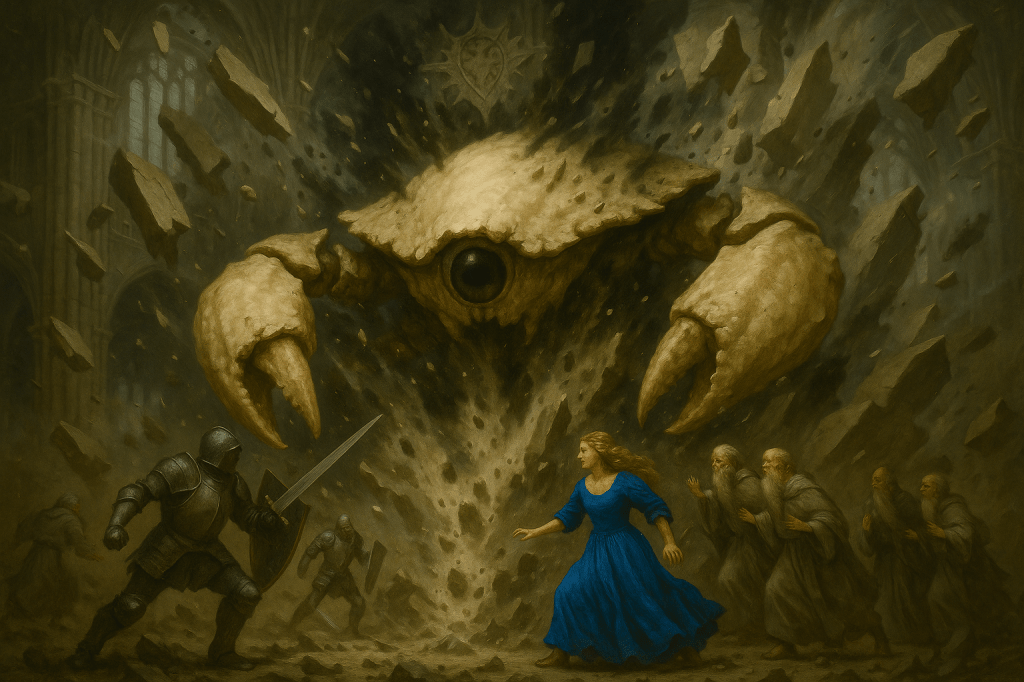
The floor began to rise, stone bowing upwards like a ship’s hull under strain.
“MOVE! Quick as you can!” Gavashoon shouted.
But the creature erupted through the floor, breaching the sermon hall in a wet thunder of shattered marble. It now filled half the room, gorged beyond design.
Still it fed, tethers drawn invisibly across Auris to its grotesque mouth, even as its eye slowly rolled in mindless ecstasy.
Then it laid eggs.
The Fire Comes
“NOW! SANCTIFIED RESTRAINT!” Gavashoon roared.
Threefold divine incantations flooded the room.
- The first caused it to twitch.
- The second made it waver, drool searing mist, its eye flickering.
- The third failed, snapped apart like brittle chalk.
“BURN IT!” came the final order.
Knights of Bahamut strode forth, divine fire burning in glyph-branded hammers and glaives.
The Magebane screamed for the first time.
It struck, a claw splintering a knight’s armor, another sent careening into stone with a sickening crack. But the fire landed true.
It shrieked and recoiled, its mass sloughing off like molten wax. It turned, seeking escape, retreating to the cistern it had once claimed.
Another wave of fire struck it mid-scuttle, and three knights followed it down.
The Final Toll
Two hours later, it lay dormant, shrunken, no larger than a dinner plate, its shell cracked, smoke leaking from the edges. It did not move.
Three Knights of Bahamut lay dead. One more would never speak again.
The eggs were destroyed, save for two, preserved in nullsteel and sealed for return to Talismonde’, where scholars would debate whether this had been miracle or madness.
The Queen ’s Lament
“It’s over,” someone said. “It’s done.”
But Gavashoon only looked at the ruin of the hall, the scorched iconography, the sundered floor, the stink of forgotten magic still hanging in the air.
“We hope,” she said. “We hope it’s done.”
Then, beneath her breath:
“May Bahamut forgive what we’ve done… and what we had to become.”
In the Wake of Hunger
Twelfth Week of Vigil and Beyond – Auris Reclaims the Light
The fires were out. The stone was cool again. And the thing that could not be named had been unmade.
But none celebrated.
The broken stones of the Great Sermon Hall were still blackened. The marble tiles buckled upward where the Magebane had erupted. The holy murals had been seared beyond recognition, Bahamut’s wings now only a hint in scorched pigment.
And yet… services resumed within a day.
A dais was set atop the shattered floor. No banners flew, only a simple brazier, lit by holy flame. No hymns of triumph were sung, only low prayers, humble chants of survival.
The Fallen: Honored Without Name
Three Knights of Bahamut, two clerics, and one archmage had perished during the subduing of the Magebane. Many others suffered lasting harm, both physical and psychic.
They were not buried with fanfare, but with sacred reverence.
Entombed within the Haloed Halls of the Faithful, the inner sanctum reserved for the church’s greatest servants, their tombs were left unnamed by command of the Queen , marked only with this inscription:
“They gave themselves against the hunger of forgetting. We remember them, so we do not remember it.”
Reconstruction and Rebirth
By decree of Queen Gavashoon, the national treasury was opened. Coins long sealed for times of war were now spent in service to peace.
- Stonecutters from Mithrin arrived within days.
- Artisan masons, builders, and carvers were summoned to repair the Spire, leaving certain burns and marks intact as memorial scars.
- The Sermon Hall would not be replaced, but rebuilt precisely, altered only in one way: a new mosaic to span the ceiling, depicting Bahamut’s wings sheltering a formless void, defense not against a creature, but an idea.
“Let the wound remind us,” said Celendra, “but not define us.”
The Unnameable Truth
And yet… the greatest challenge remained.
How do you explain what must never be named?
The Council debated endlessly.
The seers, now free of their affliction, counseled silence. Knowledge of the creature was itself an echo of it.
Thus, it was agreed:
“A threat of thought and memory rose. It was cast down by a gift from our oldest friends in Talismonde’.
Its name will not be spoken. Its story will not be taught. Only this will be said:
It is no longer with us. And if it ever returns, the fire will return with it.”
The Magebane, now reduced to a fragile husk, was sealed in soulsteel, transported with sanctified guard back to Kadathe’, along with the two surviving eggs. It would never return to Auris, not if Gavashoon had anything to say of it.
Aid and Compassion
Amid the turmoil, Gavashoon’s thoughts remained fixed on the refugees of Taurdain, still huddled in camps across the outer wards.
Many had suffered in the final mind-wave of Varnosh. Some had lost language. Others simply sat and stared, unable to recall who they were. A disease of memory, subtle, cruel, lingering.
Gavashoon begged for aid, not for herself, not for the Spire, but for them. “We are not whole,” Gavashoon said in her address to the people, “but we are alive. And that is enough to begin again.”
A New Chancellor
When the position of Lord Chancellor was at last filled, it was not with fanfare or ceremony, but quiet conviction.
Dawnmother Celendra Ilistae, the Flame of Compassion, had stood firm in the darkest hour. She did not burn the beast, but she wept for those it tried to devour. And it was she who held the line when divine fire became the final defense.
Sworn into her position with a prayer and no crown, she made her first edict simple:
“The halls remain open. The wounded may rest. The penitent may speak. And the light of Bahamut will not be dimmed by fear.”
The Memory That Lingers
The Queen still wakes some nights, alone in her chamber in the Royal Spire.
Sometimes she lights a single candle and watches its reflection in the dark mirror nearby. She does not speak. She does not pray.
She simply waits, for some echo, some tremor, some sign that it might not be over.
“We remember so that others may forget,” she once told a scribe.
“That is the price we pay.”
And so it is recorded.
So let it be left, unspoken, unresolved.
The halls of Auris stand quiet now, bathed in firelight and remembrance. Beneath the earth, the stones are still scorched. The faithful gather, the wounded recover, and Queen Gavashoon watches from her high chamber with eyes that have seen too much. There are no songs of victory. Only silence. Only scars.
And far away, in some cold corner of the world…
a thought that should not be may still drift,
tetherless, angry, and hungry.
It remembers that it was devoured.
And it remembers who made it forget.
But for now, Auris endures.
 Shermans fantasy world