Dreadnaught of the Alliance
Once known as The Sea Hag before war stripped her of any playful mockery—is a leviathan of the waves, a warship of such grim majesty and sheer force that her silhouette alone is enough to scatter lesser fleets. She was never meant to simply sail—she was built to dominate, to endure, and to bring ruin when called upon.
Towering and broad-beamed, The Hag is a Taurdain privateer in name only. In form and function, she is a floating siege engine—rebuilt and reforged again and again over the decades by the greatest living artisans of elven shipwright clans and dwarven war-forgers. What began as a swift raider in the early trade wars of the southern reaches has become, through time and blood and brilliant craftsmanship, a fearsome symbol of raw maritime power.
Her hull is crafted from seasoned ironwood, quarried from the rootgroves of the Eldertree Vale, then reinforced with internal plating of rune-bound steel forged in the halls beneath Mount Kathrak. This rare fusion of wood and metal gives her not only immense durability but also an eerie silence on the water—her mass gliding over the waves with unnatural stillness. Fire cannot touch her. Siege weaponry breaks like toothpicks against her flanks. The scars of war—burns, gouges, and shrapnel marks—are all there, but they do not mar her strength. They are decorations. Battle-born tattoos. Proof that she does not falter.
And she is not shy of weaponry.
Twenty broadside cannon ports open like the gaping jaws of a sea beast, each one housing devastating blackpowder guns capable of leveling coastal defenses or gutting enemy vessels in a single volley. Deck-mounted swivel guns and ballistae cover her flanks and upper decks—bristling like thorns on a great sea-beast’s hide—while a dozen mobile carriage guns can be wheeled and repositioned wherever the fight demands. Each piece is meticulously maintained, their barrels inlaid with sigils of precision and power, forged in secret conclaves known only to the dwarves of Thylor and the gunnery guilds of Mithrin.
To behold The Hag in full sail is to see the storm coming. Her sails—stitched from wyvern-hide and dyed a deep, smoky crimson—bear the triple flags of Auris, Mithrin, and Thylor, snapping in defiance of sky and sea alike. Her rigging sings with the strain of enchantment and old-world craft, her masts reinforced with iron-laced hardwood, and her decks built wide enough for full formations of armed marines to fight or drill in unison.
The bow carries no figurehead—it does not need one. Instead, there is a brutal elegance to her prow, a blade-like curve lined with runic teeth, designed to slice through both surf and hulls. Beneath the waterline, rumors speak of reinforced plating, a dwarven innovation meant to crush the keels of enemy ships in a headlong ram.
And yet for all her presence, The Hag is not a vessel of conquest. Not now. With the war’s end and Taurduin’s devastation, she has become a lifeline—a dreadnought bearing food, medicine, and desperately needed supplies from Auris and Mithrin to the broken remains of an island nation gasping for breath. Few other warships survived the conflict. Fewer still remain seaworthy. The Hag sails not for plunder, but for the thin hope of salvation.
Even without overt offensive intent, she moves like a threat. Her black-iron lanterns burn green in the night, her decks echo with the boots of seasoned gunners and spellwrights, and her wake churns like thunder across the sea. Every port she enters falls silent. Every dockmaster tenses. For though she brings hope now, none forget what she is capable of.
The Hag does not beg for respect.
She demands it.
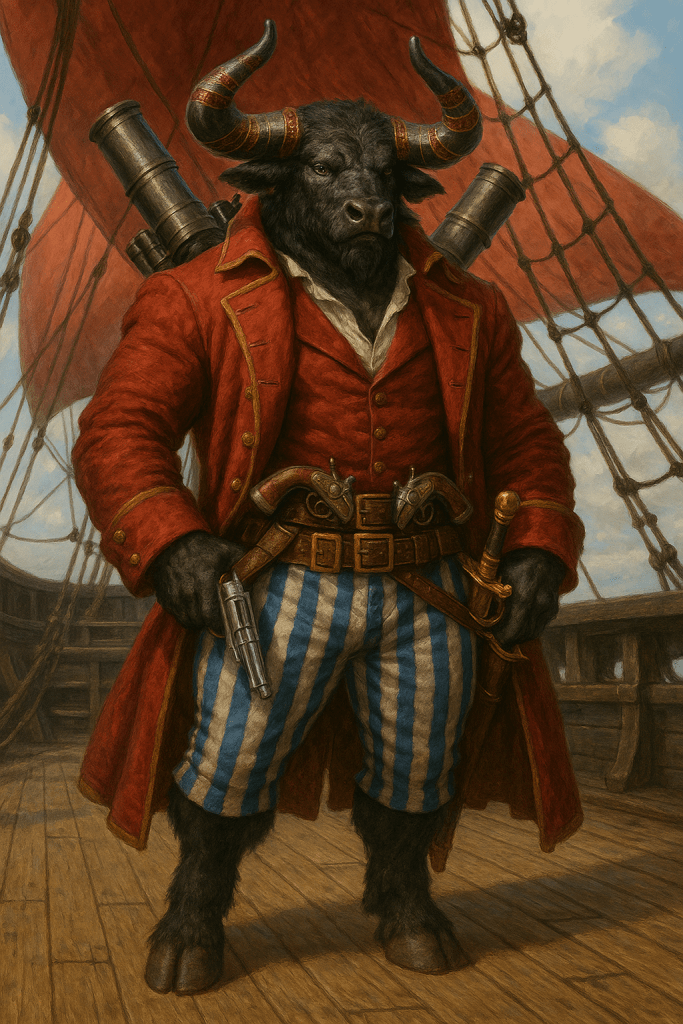
Captain Grebdin of Beezdalith is a legend walking on hooves.
Towering at over eight feet in height, this massive minotaur is a mountain of muscle wrapped in jet-black fur, his bulk rivaling even the most hardened war golems. His sweeping, forward-arched horns are polished to an obsidian sheen, etched with ceremonial bands of silver and deep crimson—each marking a rite of passage, a campaign survived, or a debt earned and paid in full. At a glance, he appears a creature born for destruction—a force of pure intimidation clad in weathered naval garb cut and tailored to fit his massive frame. Yet, despite his fearsome presence, there is a glimmer of something else in his eyes—something older, wiser, and strangely warm.
Slung across his broad back are two carriage guns—not mere muskets or hand-cannons, but full-sized, shoulder-mounted artillery of Thyloran design, crafted by the secretive gunnery guilds known to work only for the nobility of Mithrin and the Great Houses of Thylor. These rare weapons are etched with heat-resistant runes, their barrels fluted for rapid cooling, and their chambers customized for alchemical charges. Few outside of royal armories have even seen such firepower, and fewer still could lift them, let alone wield them in the middle of battle with the ease Grebdin does.
Tucked neatly into his waistband is a brace of custom-built pistols—ornate but deadly tools, each engraved with a scene from Taurdain’s bloody past. Ivory grips, mithril-cored barrels, and a complex rotating rune-lock system make them a fusion of magic and machine. To see one of these pistols is to witness decades of craftsmanship. To see a full brace of them on a single man’s belt is to know you’re looking at someone with stories too heavy to tell.
When Grebdin walks the deck of The Hag, the thunder of his hooves echoes like warning drums through the timbers, yet his posture is one of a seasoned seafarer—graceful in a way no one expects from a beast his size. He moves with quiet assurance, surefooted as any sailor bred to the sea, his deep, rumbling voice rolling out like the tide. And when he speaks, it’s with the tone of a storyteller, a brother-in-arms, or a kindly uncle—his words seasoned with wry humor, soft laughter, and a calm that soothes even the most anxious of greenhands.
There’s something disarming about him. A paradox. He carries the power of a siege engine in his arms and the patience of a grandfather in his soul. New recruits often find themselves laughing nervously in his presence, unsure whether to salute, flee, or pull up a stool.
But beneath that booming laugh and generous nature lies a scarred past. Grebdin has served the high families of Taurdain since before the Harvester War, and bears the weight of that history like another weapon on his belt. He personally fought beside Utgar VanMorian in the darkest days of the uprising and shared the blood-oath journey with Lady Gavashoon’s late husband to reclaim the cursed blade that would shift the fate of a nation. It is said he took a wound in that venture that never fully healed—though none have dared ask where.
He speaks little of that time. The mere mention of the Harvester or the Sword dims the fire in his eyes and stills his jovial tone. In those moments, the storm within him rises just enough to remind all present that this is not simply a sailor, or even a captain—but a warrior with ghosts.
After the initial disaterous naval conflict with the Talshie shattered the Sea Hag, Grebdin personally oversaw her reconstruction in Thylor, many months of untold fortunes were spent to get the ship back into the war in time for the final conflict. Enlisting both dwarven forgemasters and elven hullwrights to repair and refurbish her into the monstrous beauty she is now. Upon his return to Taurdain, Rasputin VonBlitskrieg’s estate was turned over to him—legendary pirate and former claimant to the ship—left the great vessels ownership to Grebdin in his will. She was rechristened simply as “The Hag”, in honor of her second life and the legend of her new master.
Under Captain Grebdin, The Hag has not only survived war, but become a lifeline to a broken land. And though he may greet you with a smile, a firm handshake, and a tale over rum, it is wise to remember:
Beneath that laughter is thunder.
And if ever he must rise to his full height in anger—gods help those who stand in his path.
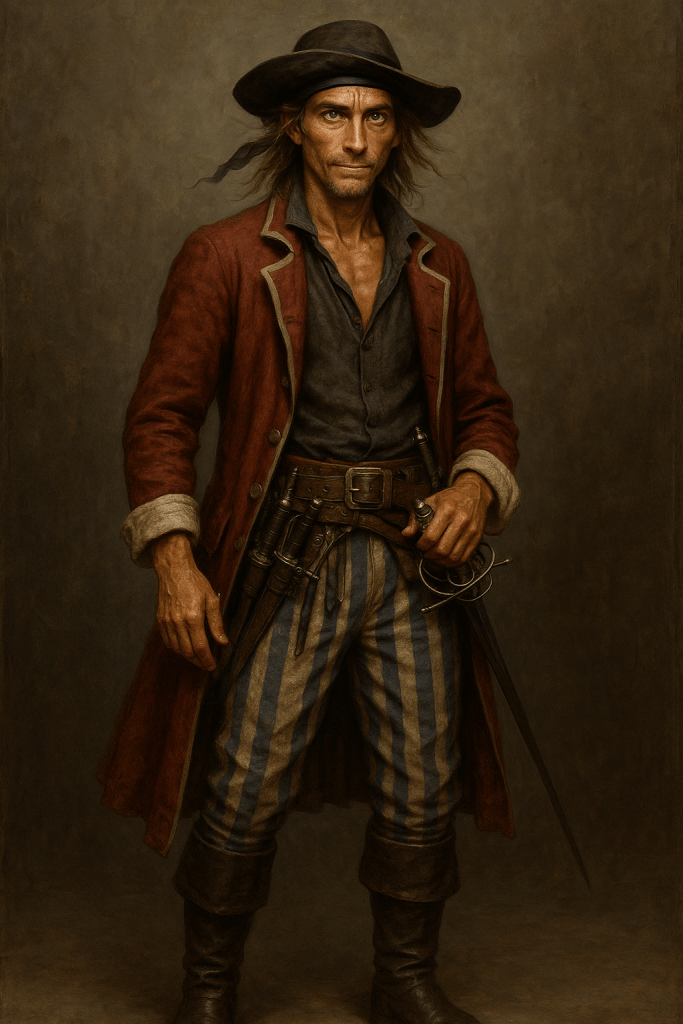
Mr. Talbot is a shadow in sailor’s clothes—a whisper wrapped in salt and silk, dressed in pragmatism and charm.
Of slight stature and indeterminate age, Talbot appears to be of mixed Gao and Saristan blood, bearing the delicate bone structure of the eastern isles with the lean muscle of a life lived on the fringe. His skin is tanned and wind-etched from years beneath unrelenting suns, and his shoulder-length sandy hair—though often tied back with a strip of black cloth—always seems to dance freely in the breeze, as if it too has a mind of its own.
His eyes, a pale and piercing gray-green, seem to catch every flicker of movement, every whisper of deceit. They flash with the sharpness of a dagger’s edge and the cold patience of someone who has spent too much time watching people lie to themselves and others. It is said he once picked out a mutineer from a glance, a thief by the twitch of a finger, and a killer by the way they blinked. If Talbot fixes you with a smile, you may feel warmed by it—but deep down, you’ll know it’s a calculated thing. Measured. Weighted.
He moves with the lithe, fluid grace of someone born on a ship’s rolling deck—never needing to adjust for the sway, never stumbling, always where he needs to be a half-second before anyone expects him. He’s quiet, efficient, and—unlike many sailors—rarely raises his voice. His commands come like a gust of wind: subtle, but impossible to ignore. The crew obeys without question. Not out of fear, but respect… and perhaps a touch of superstition.
Everyone aboard The Hag likes Mr. Talbot—how could they not? He has a roguish grin, a dry wit, and an uncanny knack for remembering the names of even the greenest deckhands. He gambles lightly, drinks little, listens well, and never overplays his hand. But make no mistake: beneath the affable mask lies something far more dangerous.
Talbot is the ship’s blade in the dark, her ghost on the dock, her eyes in every alley and smoke-filled den from Auris to the far reaches of the Whyrllish coast. Officially, he is the second mate. Unofficially, he is the spymaster, a man with strings running through every shadowy port and smugglers’ cove in the allied nations. Need black powder in a dry harbor? A priest smuggled out of a warzone? A stolen relic quietly returned to its temple? Talbot knows who to ask, what to offer, and more importantly, what not to say.
He keeps a network of informants so vast and so quiet even the admirals of Auris suspect he knows more than they do—and they’re probably right. He serves The Hag, her captain, and her shadowy patrons with unflinching loyalty, but his compass is calibrated to something older than duty. Talbot believes in justice, in the cold reckoning that comes for the wicked, the cruel, and the arrogant. He has little patience for pomposity and none at all for bullies, and his reputation for “unfortunate accidents” befalling such folk only adds to his mythos.
Vain? A touch. His boots are always polished, his cuffs neatly rolled, and his belt never quite not fashionable. He’s a man who appreciates the value of an impression—but not so much that he lingers in it. Like everything else about him, it’s part of the game.
And should you cross him? Well… you wouldn’t know it at first. He’d still greet you with that same disarming smile. Maybe ask how your evening was. Offer you a drink. But later—days or weeks or months, when you least expect it—something would come for you. Quiet. Inevitable. Untraceable.
They say Captain Grebdin steers the ship, but Mr. Talbot knows where all the secrets are buried.
And they all answer when he calls.
<perception check diff 20, Talbot uses sign language quite often to communicate silently with certain members of the crew. The subtle type used by the underworld guilds>
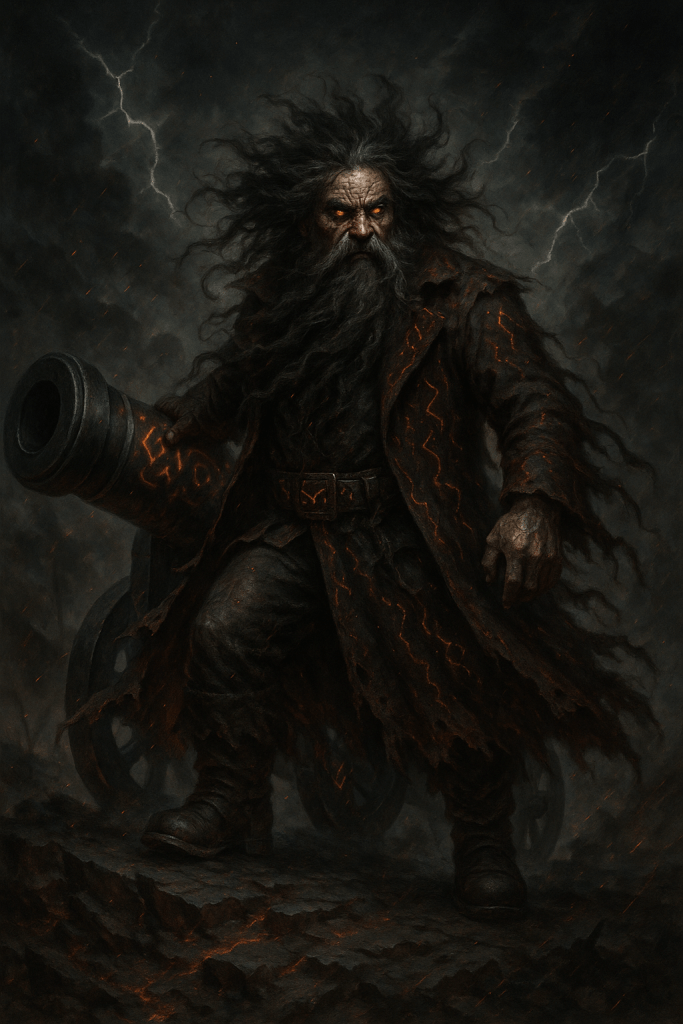
Kraglann, the Siege Master of The Hag
Kraglann is a squat, thick-limbed dwarf, built like a siege engine himself—dense, unyielding, and blackened by the fires of countless bombardments. His umber skin is pitted and marred, not just by age or the wear of time, but by the caustic kiss of cannon blast and the smothering embrace of smoke. His hair erupts in a tangled explosion of iron-gray, left wild and unsummoned by any blade. His beard, long and thick, hangs in a fire-singed curtain of ash and oil, untamed and unbraided. To most dwarves, his appearance would be an affront. To Kraglann, it’s honest.
He dresses in a manner that confounds and unsettles—thick, overcoat with overlapping layers of rough garb, befitting a dwarven artillery master. His armor, if it can be called that, is piecemeal, engraved here and there with old runes from a faith no one on The Hag can name. It hints at a deity half-forgotten and wholly unmerciful, something worshiped in ash-choked valleys far across the world from where the Thylorian navy holds sway. Yet somehow, he knows their gunnery like a lifetime native. His understanding of the ship’s Thylorian steel-cannons is intimate, obsessive. He talks to them in a tongue no one else can follow, adjusting, cleaning, and coaxing them like a mad priest tending shrines. Strange runes, carved into bone and brass, hang from his belt and collar, and though no one on board understands them, they seem to pulse when the cannons are primed. The crew speak of his god in whispers—something old, unspeaking, and hungry.
No one knows how he learned their language. No one asks.
The guns always fire true, and that’s all that matters.
Behind his deep-set eyes burns a glimmer of something dangerous—a flicker, a flash, a spark that comes and goes with no pattern. It could be rage. It could be madness. It could be something worse. Sometimes it’s there when he’s staring too long at the horizon. Other times it ignites mid-sentence, stopping his speech cold. It’s a signal few dare to interpret.
The crew of The Hag give Kraglann a wide berth. Beyond the captain and the first mate, none willingly initiate conversation. When Kraglann speaks, they answer—briefly, carefully—and when he falls silent again, they do not press. He has a presence like a loaded cannon with a fraying fuse: useful, indispensable even, but not to be trifled with. His quarters reek of blackpowder and oiled metal, and his skin carries the smell of smoke like it’s sunk into his bones.
Yet for all his silence, Kraglann’s hatred has a voice. A slow-burning, acidic contempt clings to every glance he throws toward Innarlith or her ilk. The people of that land, with their shining towers and draped silks, their dragon-blooded queen with her airs of godhood—they disgust him. Their pageantry, their noble preening, their love of fire made tame and ceremonial—it all stirs a bitter taste in his mouth. He once spat on the deck at the mere mention of her name. “Dragon Queen,” he growled, “a beast on a throne of perfume and polished bone. I’ve seen truer dragons chained in the pits of the mountain holds.”
To him, the people of Innarlith are little more than preening children playing at fire and sovereignty, oblivious to the cost of real war, the weight of ash and iron. He makes no secret of this loathing. It hangs off him like smoke, thick and choking. The crew know to steer clear of that subject—among many others.
Kraglann speaks rarely. When he does, the crew answer with the bare minimum of words, as if afraid of saying too much or too little. Only the captain and first mate address him freely, and even they carry a kind of wary respect, like handlers feeding a bear that hasn’t decided if it’s tame or not. When Kraglann falls silent—and he always does, mid-conversation, without warning—the topic dies with him. No one presses. No one lingers.
He spends too much time too close to the guns, even when they fire. Even when they scream. His coat bears the pockmarks of shrapnel and fireblast, and his boots are scorched near the toes, as if he stands where no sane man would during a broadside. And he smiles—a rare, crooked thing—only when the cannons roar, when the air shakes and the enemy shatters.
No one knows what brought Kraglann across half the world to serve aboard the merciless warship on the fringes of a dying empire. Some whisper he’s a fugitive from a war no one’s heard of. Others think he’s an exile from a dwarven hold so far-flung it may not even exist anymore. But wherever he came from, Kraglann tends the guns now.
And the guns always obey.
 Shermans fantasy world