They came in the dark, as ghosts do.
It began with fire and silence.
Near midnight, on a ridge that sloped like the jaw of a broken beast, five bodies were strung upside down. Their ankles bound in braided thornvine, they hung from cruel iron scaffolds shaped like a Y—a hateful glyph scorched with meaning, its forked arms crowned by a cross like a slashed throat. Beneath each head, a slow-burning fire smoldered, thick smoke curling upward to smother breath and scream alike. The wind carried the scent into the valley below.
The refugee camps stirred.
From their tents and lean-tos, the people of Taurdain saw the ridge alight in hellish silhouette—watched loved ones burn, helpless to act. Panic, then fury. The survivors murmured the name of the ones who had returned: Tal-Shie. The enemy, thought broken by the war, had clawed their way back from ruin. And now, they desecrated Taurdain’s soil anew.
But vengeance was coming.
Preparation for War
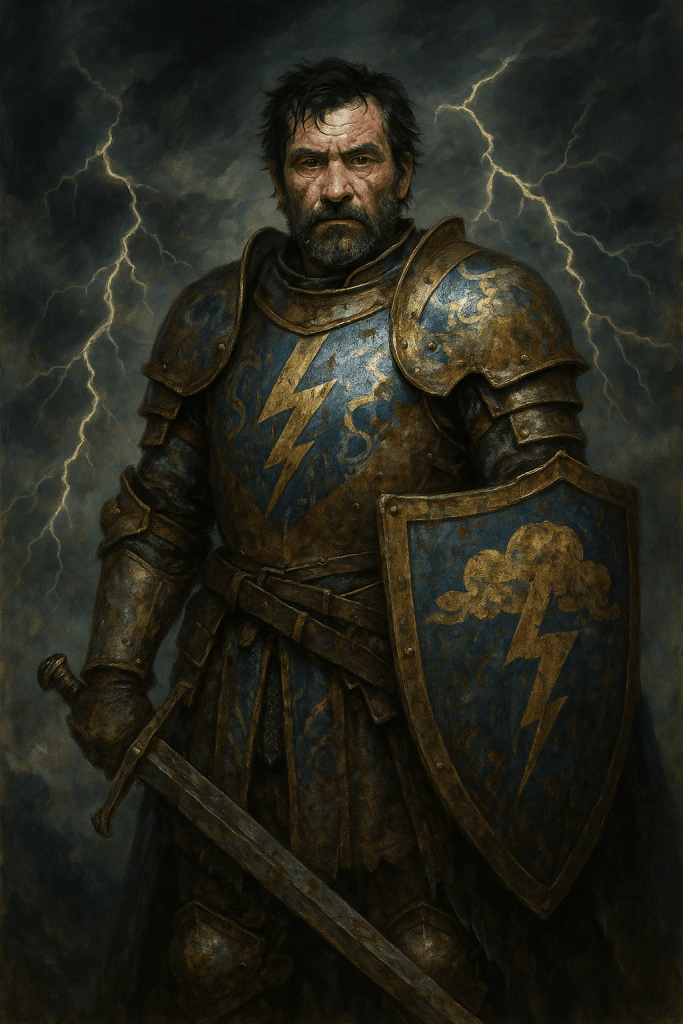
Utgar VanMorian, Lord of Taurdain, had not worn his armor since the War of the Harvester. The burnished plates, etched with Ukko’s storm sigils and the scars of battle, had rested untouched in his tent like a buried oath. But that night, he fastened the chestplate himself. No squires. No pageantry. His hands moved with grim purpose.
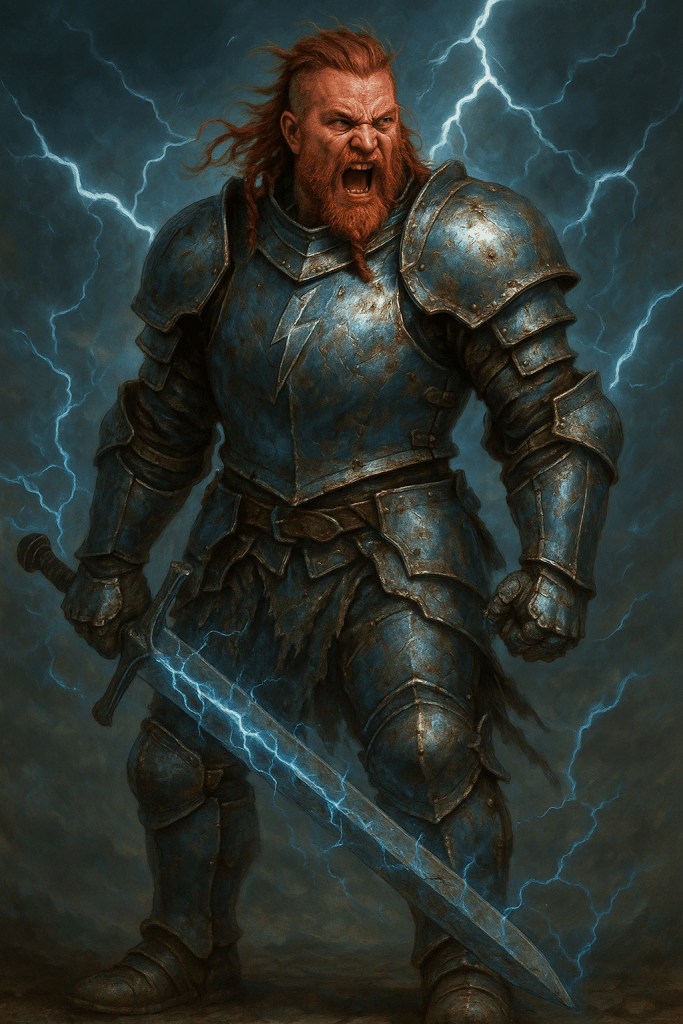
Beside him, Lars VanMorian, his younger fiery Brother and a knight of Ukko, roared with a fury that made the air seem to spark around him. While Utgar spoke with the scouts—grizzled veterans who had tracked the Tal-Shie’s passage through ash and ruin—Lars polished his blade and muttered prayer-curses to any divine ear that would grant him righteous slaughter.
The scouts returned with dark news. From the wood used in the grotesque sacrifice—greyish yewfire, from cursed hull of the Tal-Shie fireships—they had narrowed the enemy’s lair to the crashed vessel near the ruins of the clock tower. A half-sunken leviathan of brass and bone-laced timber, the ship’s broken spires still whispered residual magic into the ruined air.
The plan was bold: march openly, draw them out, strike fast and clean. The scouts would harry the Tal-Shie casters and ranged fighters while the knights and soldiers pressed forward in disciplined formation.
Before dawn, rites were laid.
Priests of Ukko and a few hedge-mages etched protective runes upon breastplates and greaves, chanting prayers of storm-warding, flame-breaking, and spiritual fortitude. Lars’s own armor wept with divine light, while Utgar’s sword glowed cold as mountain frost. They marched not as wanderers or refugees—but as the wrath of a people long denied peace.
The Battle at the Clock Tower
The enemy was waiting. The Tal-Shie had fortified the husk of their ship with crystalline barricades and half-melted wards, threading fire runes into the very earth beneath their boots. Great glyphs shimmered to life as the knights approached, bathing the rubble in the hues of molten glass and old blood.
Then—war.
The first volley came not from the Tal-Shie, but from the three hidden scouts, who loosed a coordinated hail of arrows and steel-tipped bolts from atop a collapsed bell-tower. Their aim was true. A flame-priest collapsed, throat pierced. A wind-walker stumbled, his mask shattering into shards of bone and smoke. Confusion rippled through the enemy line.
Lars roared, voice cracking like a thunderclap, and charged through the flames. His greatsword cut through skulls and shattered breastplates. Each swing was accompanied by a flash of holy reckoning—radiant light searing through elemental flesh.
A Tal-Shie firecaller leapt from the deck of the crashed ship, blade glowing red-hot, and clashed with Lars in a spray of embers. They fought amid ruins and screams, until the knight drove his weapon into the enemy’s core and was thrown back—burned, broken, but not slain.
Utgar led the second line, measured and deliberate. He fought like a shield wall come to life, conserving his strength for when the line threatened to break. He called orders above the din, rallying the wavering, finishing the wounded. His blade, Stormwake, drank the blood of earthbound fae and hissed with power.
Tal-Shie warriors hurled gouts of volcanic flame and cracked the earth itself to swallow men whole, but the knights closed in with discipline and divine fury. One by one, the Tal-Shie fell. Their magic faltered. Their discipline shattered.
The Aftermath
When silence finally fell, the airship’s husk was scorched and broken anew. Blood soaked the roots of old stone. Twelve Tal-Shie lay dead, their strange weapons twitching with lingering heat and whispering echoes.
But the cost had been heavy. Three soldiers and one knight had given their lives. Lars, barely standing, was pulled from the wreckage, his armor scorched and fused to his flesh in places. He lived—barely.
Inside the ship, they found the Tal-Shie’s hidden stockpile: preserved food, sealed spell-flasks, strange alchemical wards, and cannon-like magical weapons powered by coiled flame-runes and firestones. Not of eastern make. These were Tal-Shie weapons of old—incomprehensible and potent.
Utgar ordered them sealed and sent to the war scholars. A few cannon emplacements were salvaged and re-mounted on stone perches within the ruined city.
The refugees returned that very week. They came cautiously at first, staring at the place where the sacrifices had burned—but as days passed, life began to return to Ravensmoor. The bell tower became a rallying point. The walls were surveyed for repair. The dread of the ruins began to lift.
And so began the second breath of Taurdain. Blood-bought. Ash-born. Held not by hope alone, but by fire, steel, and the memory of what had been taken, and reclaimed.
Ash in the Blood: The Trials of Lars VanMorian
Victory came at a cost.
Though the Tal-Shie were cast down and the ridge cleansed of their wicked rites, though the smoldering ship was stripped of its monstrous arsenal and the refugees returned to their broken hearthstones with wary hope—Lars VanMorian did not rise from his cot.
The battle had nearly claimed him. But it was not merely blade or fire that felled the younger VanMorian—it was the land itself, cursed and sour, where the dead whispered through the trees and the air hung heavy with rot and unseen hunger. The people called it the wasting. It struck not like a sword but like rot beneath the skin, slow and vile. It fed first on the wounded, the weary, and the hopeless.
And now, Lars, iron Lars, storm-blooded Lars, breaker of lines and brother to Taurdain’s lord—lay still, trembling like a felled bull, fevered and pale.
He had always been a creature of wrath and will, his fighting style nearer to divine frenzy than chivalry. Where Utgar stood a wall, Lars was the thunderclap. He was muscle and fire, the smite of Ukko given flesh. During the assault on the Tal-Shie wreck, he had crashed into the enemy like a god of ruin, cleaving a path through firecallers and rock-warpers, heedless of pain or hesitation.
But the flame-wrought blade of a dying Tal-Shie struck deep beneath his pauldron, and the wasting had followed the wound like a whisper.
No miracle halted it.
They tried. Gods, they tried.
The remaining priests gave what healing they could without forsaking the rest of the encampment. Salves burned, prayers rang hollow, and charms cracked beneath the heat of his fever. The color left his cheeks. The light dulled in his eyes.
Even his strength, once the bedrock of many campaigns, waned. The righteous majesty that had so often lifted others in battle now bowed beneath a weight Lars could not lift.
Some began to whisper he would not see the season’s end—not unless the second expedition into the Burn found a source of renewal or some lost relic of Ukko’s blessing. But Taurdain’s sons were not bred to break. And none more so than Lars.
In the dawn hours, when the sky was washed gray and dust still clung to the bones of the city, Lars would rise from his cot in secret—still trembling, still weak—and make his way into the half-rebuilt districts of Ravensmoor. There he worked: hauling stone, guiding beams, barking orders in a voice hoarse with pain. His left arm, once capable of lifting an ox, now shook as he drove stakes or tried to lift a hammer. Yet he refused to stop.
When the healers found him, he snarled them away. When the guards offered aid, he cursed them in three tongues.
Only Utgar could dissuade him, and only by joining him.
So it was that the Lord of Taurdain, clad no longer in the armor of battle but in the dust-stained garb of the people, worked side by side with his brother beneath the ruined archways and shattered gates. The brothers moved in tandem—one slow and wounded, the other watchful and steady. They did not speak at first, but when they did, it was as if the war had not hollowed them.
They spoke of the days before the fall, of riding out as young men with dreams grander than wisdom, of hunting frostboars in the high country, of laughing around low fires while the banners of Taurdain snapped in the wind. And slowly, the talk turned to what could be: a city risen, a people strong again, children playing in streets no longer broken by siege or ash.
They knew death walked with them still. But they chose to speak of life.
And those who passed by—soldiers, refugees, widows, orphans—saw hope in that simple labor, in the stubborn will of a broken warrior and the quiet loyalty of his brother. It stirred something in them deeper than rallying cries or sermons. It reminded them that even in defeat, the blood of Taurdain still beat like a forge-heart.
Lars remains unhealed. The wasting gnaws, patient and cruel.
But each stone he sets is a prayer.
Each nail he hammers, a curse against the dark.
He may yet die. But if he does, it will be standing, working, and defying the land that seeks to bury him.
And should he live—then let the enemies of Taurdain tremble. For no curse, no flame, and no shadow can long hold the fury of Lars VanMorian.
The Spoils of War
In the smoldering aftermath of the Retaking of Ravensmoor, as the wounded were tended and the dead given honor, a grim task remained: to reckon with what had been left behind in the broken hulk of the Tal-Shie warship.
Within its sundered bones, amidst the scorched decks and half-melted glyphs, the soldiers of Taurdain uncovered a trove of relics and weapons unlike any known to their kin. This was not merely salvage. It was spoils from another reality, war-trophies from a realm where the laws of nature wept and burned.
The air around the relics was wrong. Thicker. Warped, as if dreams and memory tangled there like smoke in glass.
The Relics of the Tal-Shie
Foremost among the discoveries were four cannons—massive constructs of copper-veined blacksteel, etched with ever-shifting runes that refused to remain still in the corner of one’s eye. The barrels were wide and braced with binding rings of unknown alloy, humming faintly with restrained fury. When touched, they radiated heat—not from fire, but from contained elemental wrath, like living magma suspended within a whisper of thought.
No one knew how to prime or fire them.
Not even Kraglann, the grim warlock-seamaster who had once spoken of Tal-Shie arms during the siege of the southern straits, had seen these. And had the Tal-Shie unleashed them during the battle… the ridge would have burned, and the knights of Taurdain would have died screaming.
But the weapons had remained silent. Why? A mystery unanswered.
Surrounding the cannons were coils of alloyed cables, veined gem-batteries, and odd crystalline tablets whose etched surfaces pulsed softly when moonlight struck them. Among the shattered crates they also found blades that bled smoke, helms laced with nervewire, and shields that warped light like running water. More disturbing still were half-fused armor husks, likely piloted by Tal-Shie elementalists—empty now, but still echoing with some residual animus, like something had crawled out… or was waiting to return.
Mages’ Judgment
The finest minds remaining to Taurdain were gathered—runecasters, hedge-arcanists, and those few who still bore Ukko’s favor. Under the guidance of Lady Vaesindra the Prism-Eyed and Elder Wren of the Bound Sigil, they formed a circle of warding and studied the artifacts with caution bordering on terror.
Their consensus was grim.
“These relics,” Vaesindra declared, “bear the essence of realms not our own. Their power is not aligned to earth, flame, storm, or sea, but to memory, to intention, to alteration itself. They are not forged—they are grown, willed into form by beings unshaped by time.”
Exposure to the relics, even passive, caused headaches, flickers of forgotten names, hallucinations, and, in one instance, a young page attempting to remove his own eyes, convinced they were “stealing fire from him.”
It was determined that none who suffered from the Wasting Curse should even so much as brush a relic. The curse and the relics seemed to resonate, like a cracked bell answering another’s dying tone. Such a pairing, they feared, could fray the mind or unmoor the soul altogether.
The Council at Flamehearth
Realizing the peril, Utgar VanMorian called a Conclave of the Flamehearth, summoning all the mages, craftsmen, and commanders left within Ravensmoor’s rebuilt walls. They met in the hall that once served as the tower’s furnace-keep, now ringed with new forges, braziers, and salvaged glass from the Tal-Shie vessel.
Utgar stood in half-armor, his helm beneath his arm, his voice cold and clear:
“We cannot guard what we cannot understand. And we cannot afford to gamble the souls of our people on relics forged in madness and war. But nor should we cast it into the sea like cowards.”
He proposed they send the entire trove—unchanged, unsorted, and whole—aboard the next voyage of The Hag to Kraggenkor Forge in Mithrin, where the great artificers of the west still held their secrets close and their minds sharp.
“Let Garbrik and his iron-thought kin see what they can make of it. If we are cursed, let it be cursed wisely. If there is boon within this blight, let them draw it out like gold from blood.”
The council agreed.
Bound for Mithrin
The relics were sealed in runed iron vaults, watched night and day by untainted guards, and stored aboard The Hag with sacred wards inked by both druid and cleric. Aboard the dreadnought, Kraglann was seen pacing, already whispering to the crates, perhaps deciphering secrets none else could grasp.
Some whispered that it was folly to carry such fire into another land. Others feared Garbrik, master-metalmind of Mithrin, might unearth weapons that could reshape the world—or burn it anew.
But the people of Taurdain had learned that stagnation was death. And so they chose danger. They chose purpose.
What came of those relics… only time will tell.
But that moment marked a turning point in Taurdain’s fate: not just a reclaiming of land, but the beginning of a reckoning with powers far stranger—and perhaps far greater—than any had dared imagine.
 Shermans fantasy world